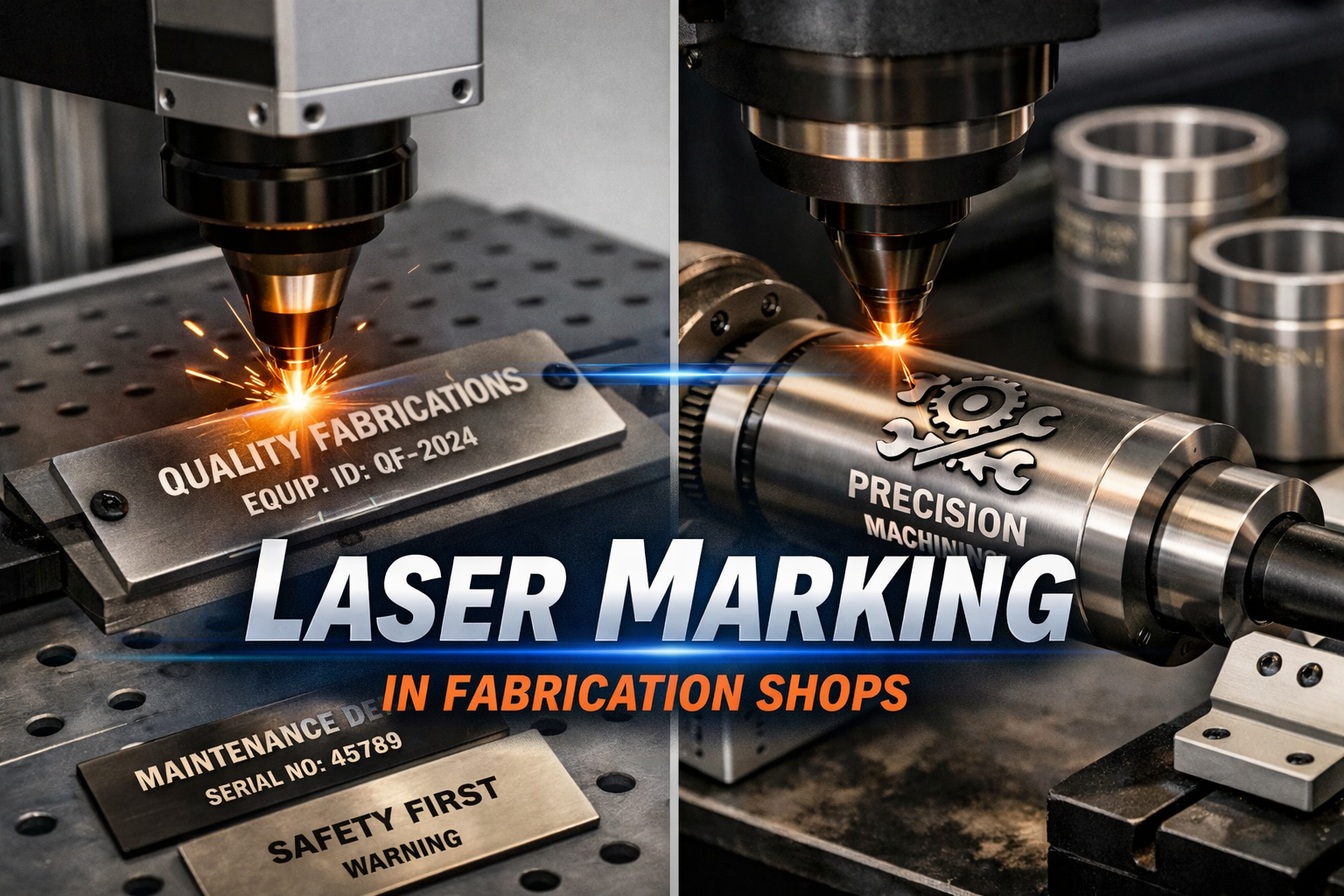
A Supporting Blog — Laser Cutting and Marking Machines for Construction
1. Introduction: The Traceability Challenge in Modern Fabrication
In modern construction, a structural component or assembly without clear, permanent identification is a liability. Whether it is a missing part causing confusion on a job site, an auditor flagging a compliance issue, or an engineer trying to verify a material grade, tracking components manually is a major workflow bottleneck.
Traditionally, fabrication shops relied on mechanical metal stamps, manual tags, or paint pens to mark parts. These methods are slow, prone to human error, and easily erased by weathering, galvanization, or heavy protective coatings.
The industry is undergoing a shift. High-speed, permanent fiber laser marking allows structural steel fabricators, PEB manufacturers, and architectural metal shops to automate tracking. This guide breaks down how implementing industrial nameplate production and rotary laser marking solves the traceability dilemma, speeds up downstream assembly, and adds massive value to your operation.
Note: This is a supporting article within a broader guide on laser technology for construction. For the full overview of how laser systems transform structural work, read the Laser Cutting and Marking Machines for Construction — Pillar Blog.
2. Section 1: Industrial Nameplates — Compliance, Branding, and Asset Tracking
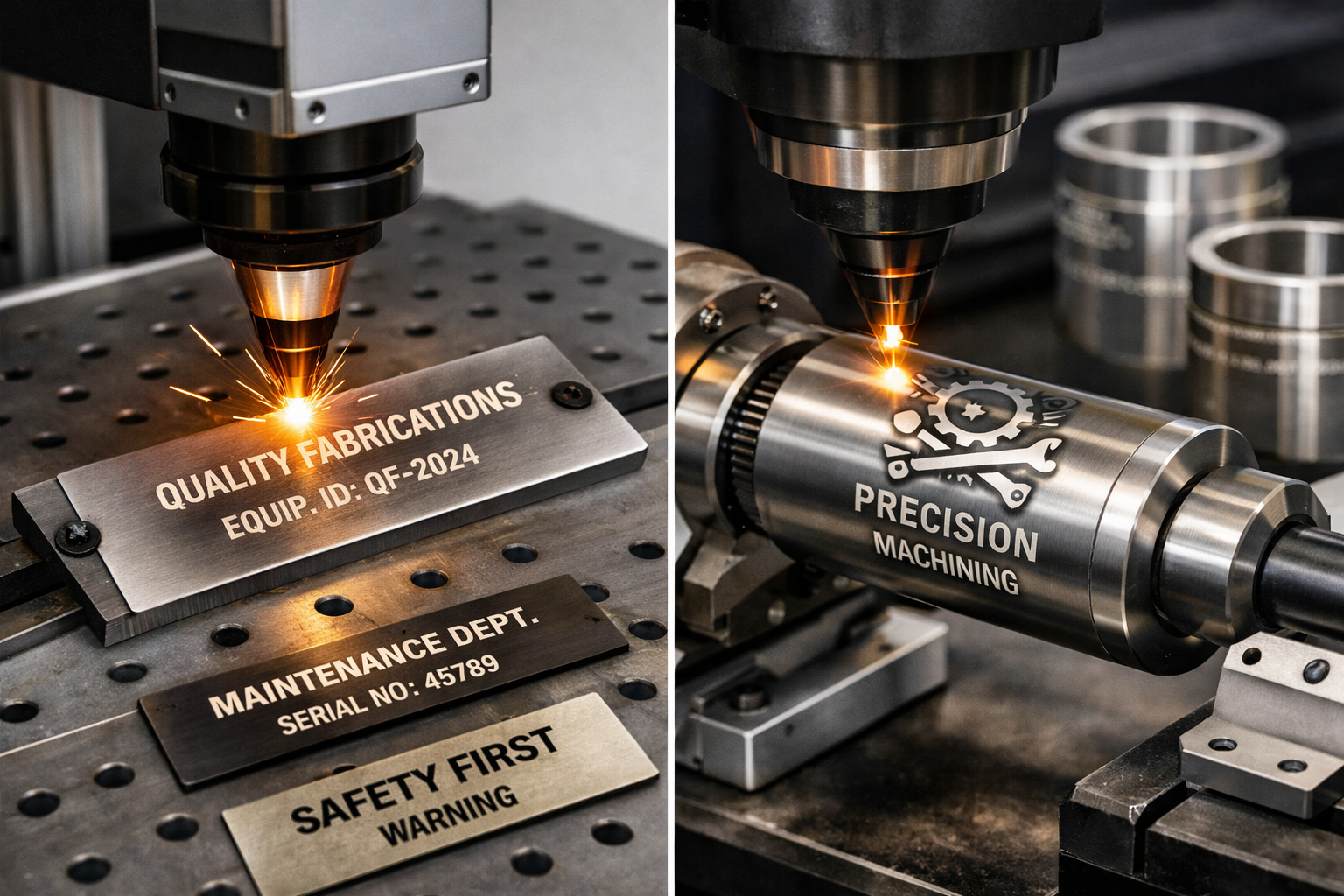
Heavy-duty construction environments demand identification that survives extreme conditions. Industrial nameplates are a critical requirement for structural steel assemblies, electrical control panels, HVAC systems, and heavy equipment.
Material Compatibility and Durability
Fiber laser marking machines excel at creating high-contrast, indelible marks on rugged fabrication materials, including:
- Stainless Steel (304/316): Resists corrosion; lasers can create a dark, annealed mark without removing material or compromising the metal’s rust resistance.
- Anodized Aluminum: The laser vaporizes the colored anodic layer, revealing a brilliant, high-contrast white mark beneath.
- Brass and Copper: Highly reflective metals easily handled by modern fiber laser sources.
Data Density and Variable Tracking
Unlike mechanical engraving, which is slow and limited by font sizes, a laser marking machine can effortlessly etch high-density data into tiny spaces. This includes:
- Dynamic 2D DataMatrix and QR Codes: Operators or site inspectors can scan these with a mobile device to instantly pull up material test certificates (MTRs), shipping data, or CAD drawings.
- Serialized Arrays: The software automatically updates sequential serial numbers, manufacturing dates, and batch codes from part to part without manual reprogramming.
The Commercial Advantage
Bringing nameplate production in-house transforms a fabrication shop into a premium, one-stop supplier. Instead of outsourcing mandatory data plates—which adds lead time and shipping costs—you can deliver fully compliant, professional, branded components directly to your clients.
3. Section 3: Deep Dive into Rotary Laser Marking for Pipes and Tubes
Marking flat surfaces is straightforward, but construction fabrication relies heavily on cylindrical profiles like round pipes, structural tubes, columns, and railings. Marking these shapes requires a specialized tool: a rotary axis accessory.
The Mechanics of Rotary Laser Marking
A rotary attachment features a motorized chuck that holds and spins the cylindrical workpiece. As the profile rotates, the laser marking software dynamically calculates the curvature, firing the laser beam in perfect synchronization with the physical rotation. This maintains a consistent focal distance, ensuring that the mark remains perfectly sharp and undistorted all the way around the tube’s circumference.
Core Construction Applications
- Layout and Alignment Guides: Instead of workers spending hours using tape measures and chalk lines to mark weld locations, the laser etches precise alignment guides, degree markers, and layout lines directly onto the tube. This dramatically accelerates downstream assembly and fit-up accuracy.
- foolproof Handrail and Railing Tracking: For complex architectural railing systems, every single baluster and post can be laser-etched with a unique ID around its circumference, making site installation a simple “plug-and-play” puzzle.
4. Section 4: Hardware Specifications to Look For
When purchasing a laser marking setup for a busy fabrication environment, focusing solely on the price tag can leave you with an underpowered tool. Fabricators must evaluate three core hardware metrics:
Laser Source Type and Power
- Fiber Laser (20W to 50W): This is the gold standard for metal fabrication shops. A 20W source is excellent for crisp, fast text and barcode marking. Upgrading to a 30W or 50W source allows for deeper engraving (engraving deep enough to survive post-weld sandblasting and thick industrial painting coatings) and faster cycle times.
Rotary Chuck Capacity
- Standard rotary attachments are built for light laser engraving (e.g., promotional pens or small tubes). A construction fabrication shop must specify a heavy-duty industrial rotary chuck capable of handling the weight, length, and diameter constraints of actual structural profiles, pipes, and heavy hollow sections without slipping or causing positional error.
Enclosure Safety (Class 1 vs. Class 4)
- Class 1 (Fully Enclosed): The laser operates inside a sealed, light-tight cabinet. This is highly recommended for open, busy shop floors because it requires no special safety eyewear or dedicated laser-safe rooms.
- Class 4 (Open System): Designed for marking oversized parts that cannot fit inside a box. This setup requires a strict, dedicated safety perimeter and specialized laser-safe goggles for everyone in the area to prevent permanent eye damage from stray reflections.
5. Section 5: Software Integration — From Drawing to Etching
A laser marker is only as efficient as the software driving it. If your shop operators have to manually re-type serialization sequences or struggle to import files, your machine becomes a bottleneck.
Automated Data Import
Look for marking software that seamlessly reads vector formats like DXF, STEP, or IGES. The software should be able to instantly map out the drawing data and convert it into high-speed marking paths.
Dynamic ERP and Production Integration
Modern, digitally integrated fabrication shops use Enterprise Resource Planning (ERP) or Manufacturing Execution Systems (MES) to track workflow. The ideal laser marking software links directly to these systems. When a job batch is loaded, the software pulls the data instantly, generating the correct serial numbers, part IDs, and tracking bar codes automatically. This eliminates the risk of human typographical errors entirely.
6. Section 6: The ROI Case — Hidden Labor Savings
Fabrication shop owners often view part marking as a secondary expense, completely missing the massive amount of hidden labor wasted on manual layout, tagging, and correcting missing-part errors.
The table below breaks down the direct operational differences between traditional manual processes and automated laser marking:
| Marking Metric | Traditional Methods (Metal Stamps / Tags) | Fiber Laser Marking & Rotary Systems |
| Marking Speed | Slow; requires manual positioning, striking, or attachment. | Ultra-fast; marks complex text, grids, and codes in seconds. |
| Durability & Permanence | Poor; ink smudges, stamped marks fill with paint, and tags rip off. | Exceptional; indelible, deep-etched marks survive weather and coatings. |
| Human Error Risk | High; misread numbers, inverted stamps, and lost paperwork are common. | Near-zero; driven by automated digital sequences directly from CAD data. |
| Design Flexibility | Extremely rigid; limited to fixed alphanumeric stamp blocks. | Fully dynamic; instantly switches between fonts, shapes, logos, and QR codes. |
| Downstream Value | None; requires manual cross-referencing on the shop floor or site. | High; enables instant scanning for digital tracking and error-free assembly. |
Conclusion & Next Steps
Implementing industrial nameplate production and rotary laser marking is not just about compliance—it is about establishing a flawless, automated tracking system that saves your shop time and money. By transforming manual parts labeling into an ultra-precise, digital workflow, you eliminate errors, speed up welding fit-ups, and elevate the overall professionalism of your structural fabrication work.
Related Posts
Laser Marking Machine for Rotary and Name Plates in Construction Fabrication
A Supporting Blog — Laser Cutting and Marking Machines for…
Cooker Cutting Laser Machine for Kitchenware Manufacturers
A Supporting Blog — Laser Cutting and Marking Machines for…
Laser Welding Machine for Metal Fabrication Shops
A Supporting Blog- Laser Cutting and Marking Machines for Construction…