A Supporting Blog — Laser Cutting and Marking Machines for Construction
1. Introduction
There is no single best laser cutting machine for construction fabrication — because construction fabrication is not a single thing.
A railing manufacturer cutting thin stainless steel hollow sections needs a completely different machine from a PEB fabricator cutting thick-wall RHS at high volume, which is different again from a structural plate shop cutting heavy gussets and base plates. The machine that is best for one of these shops would be wrong for the other two.
This guide cuts through the confusion. It starts by identifying which type of machine your shop actually needs — flatbed, tube laser, or combination — and then covers the specifications that matter within each type, the power range that fits construction work, the software requirements, the after-sales support criteria that matter specifically in India, and a step-by-step checklist for shortlisting the right machine before you talk to any supplier.
By the end of this guide, you will know exactly what to look for, what questions to ask, and how to evaluate any machine — regardless of brand or origin — against your actual production requirements.
This is a supporting article within the broader guide on laser technology for construction fabrication. For the complete overview, read the Laser Cutting and Marking Machines for Construction — Pillar Blog.
2. The Two Machine Types Every Construction Fabricator Must Understand First
Before comparing power ratings, brands, or prices, you need to answer one question: do you cut flat material, structural profiles, or both?
The answer determines which category of machine you need — and buying the wrong category is a more expensive mistake than buying the wrong specification within the right category.
Flatbed Laser Cutting Machines
A flatbed laser cutting machine cuts flat sheets and plates lying on a horizontal bed. It handles mild steel plate, stainless steel sheet, aluminium sheet, and any other material that can be laid flat. In construction fabrication, flatbed machines are used for cutting brackets, gusset plates, cladding panels, base plates, door frames, and any other flat component.
A flatbed machine cannot cut a structural hollow section, a round pipe, or any profile that is longer than the machine’s bed. For structural profile work, it is the wrong machine regardless of its power or quality.
Tube Laser Cutting Machines
A tube laser cutting machine holds structural profiles — round pipe, SHS, RHS, I-beam, C-channel, angle iron — in a rotating chuck and cuts them from any angle in a single automated operation. It handles length cutting, mitre ends, cope joints, saddle cuts, holes, and slots along the profile’s length. It cannot cut flat sheet.
For railing fabricators, frame builders, and PEB manufacturers, the tube laser machine is the machine that transforms production — not the flatbed. Buying a flatbed machine when your bottleneck is structural profile cutting solves the wrong problem.
Combination Machines
Combination machines integrate both flatbed and tube cutting capability in a single machine — the cutting head serves both a flat sheet bed and a tube chuck loading system. They are a practical option for smaller shops that do both sheet and profile work but cannot justify two separate machines. The trade-off is that combination machines are typically not as optimised for either application as a dedicated machine would be.
| Factor | Flatbed Laser | Tube Laser | Combination Machine |
| Primary Use | Sheet and plate cutting | Hollow sections, pipes, profiles | Both sheet and profiles |
| Construction Fit | Brackets, panels, plate | Frames, railings, PEB members | Mixed fabrication shops |
| Max Profile Type | Flat only | Round, SHS, RHS, I-beam, channel | Both |
| Capital Cost | Medium | Higher | Highest |
| Floor Space | Compact | Long (6m–12m footprint) | Largest |
| Best For | Sheet metal shops, plate fab | Frame and railing fabricators, PEB | Smaller diversified shops |
| Automation Options | Exchange table, auto-load | Bundle loader, auto-sort | Varies by model |
Watch Out: The most common buying mistake in construction fabrication is purchasing a flatbed laser machine when the real production bottleneck is structural profile cutting. Identify your bottleneck before specifying your machine type.
For a detailed explanation of tube laser cutting applications in construction, read Why Tube Laser Cutting Is Useful for Construction Frames and Railings.
3. What Makes a Laser Cutting Machine Right for Construction Work
Construction fabrication has specific requirements that differ from general sheet metal fabrication or light manufacturing — and the machine that is best for a signage shop or a kitchen equipment manufacturer may not be the best choice for a structural steel fabricator.
Material Range and Thickness
Construction fabrication works primarily with mild steel — from 3mm sheet for secondary components through to 25mm plate for heavy structural connections. Stainless steel appears in architectural elements, railings, and kitchen equipment. Aluminium is used for cladding and lightweight structures. The machine must handle the full range of materials and thicknesses your shop processes, not just the most common ones.
Profile Variety
Unlike a sheet metal shop that primarily works with flat material, a construction fabrication shop processes multiple profile types — flat plate, hollow sections in multiple sizes, and often open sections like I-beams and channels. A machine that handles only round pipe and SHS but not I-beam or channel is not fully suited to construction fabrication work.
Volume and Shift Requirements
Construction fabrication shops typically run medium-to-high production volumes — multiple sheets or profiles per shift, often on two shifts. The machine must be able to sustain this throughput reliably. Reliability matters more in a high-volume construction environment than in a low-volume jobbing shop, because downtime on a production machine affects delivery commitments to construction sites.
Durability and Build Quality
Construction fabrication is a demanding production environment. Machines run hard, often in dusty and vibration-prone environments. The mechanical components — linear guides, drive systems, chuck mechanisms — need to be robust enough to maintain cut quality across years of heavy-duty use. This is one area where the cheapest machine is rarely the right machine for a construction fabrication context.
After-Sales Support
For a construction fabrication shop in India, after-sales support is arguably the most important specification of all. A machine that sits idle for two weeks waiting for a spare part or a service technician costs far more than the difference in purchase price between a well-supported and a poorly-supported machine. This topic gets its own dedicated section — Section 9 — because it deserves it.
4. Best Flatbed Laser Cutting Machines for Construction Fabrication
A flatbed laser cutting machine for construction fabrication needs to handle mild steel plate up to 20mm–25mm, cut accurately at production speed, and run reliably on a two-shift cycle.
What Flatbed Machines Are Best Used For in Construction
- Structural brackets, gussets, and connection plates cut from flat plate
- Base plates and column cap plates in heavy structural steel
- Cladding panels, fascia, and architectural sheet metal components
- Door frames, window surrounds, and sheet metal building components
- Secondary steelwork components cut from flat bar and plate
Key Specifications for Construction Flatbed Machines
Bed size: Standard 1500mm x 3000mm covers most construction plate work. For larger base plates or cladding panels, a 2000mm x 4000mm format may be needed. Match bed size to your largest regular component, not your average component.
Laser power: For construction plate up to 16mm, 3kW to 6kW is the standard range. For heavy plate up to 25mm, 6kW to 12kW is needed. See the power guide table in Section 7 for specific recommendations.
Exchange table: For production volumes above 10 sheets per shift, an exchange table — where one sheet is being cut while the next is being loaded — significantly improves throughput. For lower volumes, a single table is adequate.
Cutting head: Auto-focus cutting heads that adjust focal length automatically for different material thicknesses reduce setup time when switching between materials. For shops processing multiple thicknesses, this is a valuable feature.
Nesting software: For construction plate work where steel is expensive, nesting software that maximises material utilisation on every sheet directly reduces material cost per part. Evaluate nesting efficiency as seriously as cutting speed.
Pro Tip: For a construction fabrication shop primarily cutting mild steel plate up to 16mm in medium-to-high volume, a 4kW to 6kW flatbed fibre laser with an exchange table covers the full range of typical structural plate work at production speed.
5. Best Tube Laser Cutting Machines for Construction Fabrication
For construction frame fabricators, railing manufacturers, and PEB producers, the tube laser cutting machine is the single most impactful investment available — because it replaces the most labour-intensive operations in structural profile fabrication.
What Tube Laser Machines Are Best Used For in Construction
- Steel frames for industrial sheds, warehouses, and commercial buildings
- Railing posts, balusters, handrail components, and staircase stringers
- PEB primary and secondary framing members — rafters, columns, purlins, girts
- Structural brackets and connection hardware fabricated from hollow section
- Truss members, bracing elements, and mezzanine floor supports
Key Specifications for Construction Tube Laser Machines
Maximum tube diameter: For standard construction hollow section work, a machine handling up to 220mm diameter covers SHS up to 160x160mm and most common round pipe. For PEB primary frames using larger sections, a machine rated to 350mm is recommended.
Wall thickness capacity: Determined by laser power. For standard SHS and RHS up to 8mm wall, 3kW to 6kW is adequate. For heavy structural sections up to 14mm wall, 6kW to 9kW is needed.
Loading length: Standard 6m loading handles most construction profile work. PEB fabricators processing 9m or 12m stock lengths need extended loading capacity — this must be confirmed before purchase, not assumed.
Chuck configuration: Single chuck for lighter profiles and shorter lengths. Dual chuck for heavy sections, long members, and PEB work where vibration and positional accuracy on long profiles matter.
Profile type support: Confirm that the machine handles all profile types in your production mix — round, SHS, RHS, I-beam, channel, and angle. Not all machines handle open sections as standard.
Pro Tip: For a construction fabrication shop doing standard frame and railing work with hollow sections up to 200x200mm and wall thicknesses up to 8mm, a 4kW to 6kW dual-chuck tube laser with 6m loading capacity is the most versatile starting specification.
For a complete machine selection guide covering all tube laser specifications in detail, read How to Select a Tube Laser Cutting Machine for Construction Fabrication.
6. Best Combination Machines — Flatbed and Tube in One
A combination laser cutting machine integrates flatbed sheet cutting and tube profile cutting into a single machine — one laser source, one cutting head, two capabilities.
What Combination Machines Offer
The cutting head in a combination machine can serve either a flat sheet cutting bed or a tube chuck loading system, switching between configurations with a setup changeover. This means a single machine investment covers both the flat plate work and the structural profile work that a construction fabrication shop needs — without purchasing two separate machines.
When a Combination Machine Is the Right Choice
- Smaller fabrication shops: A shop that does both sheet and profile work but at volumes that do not justify two dedicated machines — a combination machine is the right entry point into laser cutting.
- First-time laser buyers: A shop transitioning from traditional methods that wants to evaluate both flatbed and tube laser cutting before committing to dedicated machines for each.
- Diversified fabricators: Shops that process a wide variety of construction components — some flat, some profile — in mixed batches where frequent switching between modes is acceptable.
The Trade-Offs
Combination machines are not as optimised as dedicated machines for either application. A dedicated flatbed machine will typically have a larger bed, faster sheet exchange, and better nesting performance than the flatbed mode of a combination machine. A dedicated tube laser will typically handle a wider range of profile sizes, longer members, and heavier sections than the tube mode of a combination machine.
For high-volume shops where both sheet and profile work are done continuously at production pace, two dedicated machines — one flatbed, one tube laser — will outperform a single combination machine in throughput and capability.
Key Insight: Buy a combination machine when volume does not yet justify two dedicated machines. Plan for the point when volume does justify two dedicated machines and factor that into your capital planning.
7. Laser Power Guide — Matching Machine Power to Construction Work
Laser power is the specification fabricators most commonly get wrong — either buying too little power for the thicknesses they cut, or over-specifying power they will never use.
The table below maps construction fabrication applications to the recommended power range. Use it to identify the minimum power you need, then consider whether your production is likely to grow into thicker material or higher volume work within the machine’s expected life.
| Application | Material | Thickness Range | Recommended Power | Machine Type |
| Light structural plate | Mild steel | Up to 6mm | 1.5kW – 3kW | Flatbed |
| Standard structural plate | Mild steel | 6mm – 16mm | 3kW – 6kW | Flatbed |
| Heavy structural plate | Mild steel | 16mm – 25mm | 6kW – 12kW | Flatbed |
| Stainless cladding/panels | Stainless steel | 0.8mm – 6mm | 2kW – 4kW | Flatbed |
| Light hollow sections | Mild/SS steel | Up to 4mm wall | 1.5kW – 3kW | Tube laser |
| Standard construction SHS | Mild steel | 4mm – 8mm wall | 3kW – 6kW | Tube laser |
| Heavy PEB profiles | Mild steel | 8mm – 14mm wall | 6kW – 9kW | Tube laser |
| Mixed sheet + profile | Mild/SS/Al | Up to 12mm | 4kW – 6kW | Combination |
Why the Minimum Power for Current Work Is Often the Wrong Choice
A machine operating at the limit of its power rating — cutting the thickest material it can handle — does so at reduced speed and with compromised edge quality compared to the same machine cutting well within its rated range. Buying a machine with a power rating that comfortably exceeds your current maximum thickness gives better edge quality, faster cutting on your regular work, and headroom for growth.
The Cost of Getting Power Wrong
Underpowered: the machine cannot cut your thickest structural sections, forcing that work back onto manual methods and defeating part of the purpose of the investment. Overpowered: you pay a premium for capability you never use, and the return on that premium never materialises. The right power choice is one tier above your current maximum requirement — enough headroom for growth without excess.
Watch Out: Never specify a machine based solely on your thinnest or most common material. Always check whether the machine handles your thickest material at acceptable speed and edge quality — this is what determines whether the machine covers your full production range.
8. Software — Why It Is as Important as the Machine
A laser cutting machine is only as productive as the software that drives it. In construction fabrication, where part programs are derived from structural drawings and production runs change frequently, software quality directly determines how much of the machine’s capability you actually use.
Nesting Software
Nesting software arranges parts on the cutting sheet or along the profile length to minimise material waste. For construction fabrication where structural steel is expensive, the difference between a 70% and an 85% material utilisation rate on every sheet represents significant material cost savings across a year’s production. Evaluate nesting software by asking the supplier to demonstrate it on a realistic batch of your own parts — not a curated demonstration.
CAD/CAM Compatibility
Structural drawings in construction fabrication are produced in DXF, DWG, STEP, or STP format. The machine’s CAM software must import these formats directly — without a conversion step that adds programming time to every job. Ask the supplier to confirm which formats are natively supported and which require conversion.
Programming Speed
In a construction fabrication shop processing many different part types, the time to programme a new part from a drawing is a real production cost. The best systems take a few minutes to go from imported drawing to validated cutting program. Poor systems require significant manual input for every part, creating a programming bottleneck that limits how many different jobs the shop can run per week.
Simulation and Collision Detection
For tube laser machines cutting complex profiles with multiple features, simulation software shows a 3D animation of every cut and repositioning move before the machine runs. This catches collisions between the cutting head and the profile — preventing damage that can be expensive to repair. For tube laser machines especially, simulation is not optional.
Production Tracking and ERP Integration
Shops that track production digitally benefit from software that exports machine data — cycle times, material used, parts produced — directly to their ERP or job costing system. This eliminates manual data entry and gives real-time visibility of production progress. Confirm whether this integration is available and what implementation is required.
For detailed software evaluation criteria in the context of tube laser machine selection, read How to Select a Tube Laser Cutting Machine for Construction Fabrication.
9. After-Sales Support in India — The Deciding Factor for Construction Fabricators
For a construction fabrication shop in India evaluating laser cutting machines, after-sales support is not one criterion among many — it is the criterion that determines whether the investment delivers its promised return or becomes an expensive source of frustration.
Why After-Sales Matters More for Construction Fabrication
A construction fabrication shop runs a laser machine at production pace — often two shifts, five or six days a week. When the machine stops unexpectedly, it is not a minor inconvenience. It is a halted production line, delayed deliveries to a construction site, and potentially a contractual penalty. The cost of one unplanned downtime day on a production laser machine often exceeds the cost difference between a well-supported and a poorly-supported machine.
Service Response Time
How quickly can a qualified service technician reach your facility? For machines supported by a local service team in your region, the answer should be same-day or next-day for critical breakdowns. For imported machines with no Indian service presence — where a fault requires a technician from overseas or a spare part from the country of manufacture — the answer may be two to four weeks. Ask for the committed service response time in writing before purchasing.
Spare Parts and Consumables
Laser machine consumables — protective lenses, nozzles, and other wear items — need to be available in India, not on order from abroad. Ask every supplier: where are spare parts stocked in India, and what is the typical delivery time to your facility for the most commonly replaced items? A machine that stops because a consumable is unavailable locally for two weeks is a machine that is not earning its cost.
Training Quality
The quality of operator training determines how quickly your team reaches full machine productivity. A thorough training programme — ideally delivered at your facility on your actual parts — gets a new operator to productive independence in three to five days. Cursory training that covers only basic operation leaves operators unable to handle programming changes, troubleshoot faults, or optimise cutting parameters for different materials.
Questions to Ask Every Supplier About India Service
- How many service engineers do you have based in India, and where are they located?
- What is your committed response time for a machine-down situation at my facility?
- Which consumables and spare parts do you stock in India, and where?
- Can I speak to three fabrication shops in India that are running this machine and have needed service?
- What is included in the warranty, and what is the process for raising a warranty claim?
Pro Tip: The best way to evaluate after-sales quality is to call fabrication shops already running the machine you are evaluating. Ask them directly: when the machine needed service, how long did it take, and was the experience acceptable? This single conversation is worth more than any supplier’s service commitment.
10. Total Cost of Ownership — How to Compare Machines Fairly
Comparing laser cutting machines by purchase price alone produces a misleading ranking. The machine with the lowest purchase price may have the highest total cost over a five-year ownership period — through higher running cost, more downtime, greater consumable use, or lower throughput.
| Cost Component | With Laser Machine | Without Laser Machine |
| Capital Cost | Higher (machine purchase) | Lower (existing tools) |
| Labour per Part | Low — automated cutting | High — manual cutting + grinding |
| Post-Processing | Minimal or none | Significant — grinding, deburring |
| Material Waste | Low — efficient nesting software | Higher — manual layout waste |
| Rework and Scrap | Low — consistent CNC accuracy | Higher — manual variation |
| Throughput per Shift | High — fast, continuous operation | Lower — manual bottlenecks |
| 5-Year Cost per Part | Lower at medium-high volume | Higher total labour and waste cost |
How to Calculate Your Payback Period
A simple payback calculation: identify the monthly cost of the operations the laser machine will replace — manual cutting labour, grinding and finishing labour, consumables on existing equipment, rework cost from inconsistent quality. Subtract the monthly cost of owning the laser machine — depreciation or lease payment, operating cost, maintenance allowance. The remainder is the monthly net saving. Divide the net machine cost by the monthly net saving to get the payback period in months.
For most construction fabrication shops with sufficient volume, a tube laser machine pays back in 18 to 36 months. A flatbed laser machine for structural plate work typically pays back in 24 to 48 months depending on volume and the cost of current manual operations it replaces.
Financing Options
Outright purchase maximises the long-term economic benefit but requires the full capital upfront. Lease and hire purchase options spread the cost over the machine’s working life, preserving working capital. In many cases, the monthly lease payment is covered by the monthly labour saving from the first month of production — making the machine self-financing from day one. Ask your supplier what financing options are available and model the cash flow for each before deciding.
Pro Tip: Model three scenarios before deciding: outright purchase, 36-month lease, and 60-month lease. Compare monthly cash flow, total cost, and payback period for each. The right financing structure depends on your shop’s current cash position and growth plans.
11. Checklist — How to Shortlist the Right Machine for Your Shop
Use this six-step process before approaching any supplier. Completing it ensures that every supplier conversation is based on your actual requirements, not on what the supplier wants to show you.
Step 1 — Define Your Profile Mix
List every type of material and profile your shop cuts: flat sheet, flat plate, round pipe, SHS, RHS, I-beam, channel, angle. This determines whether you need a flatbed machine, a tube laser machine, or both. Do not proceed to machine specifications until this question is answered.
Step 2 — Determine Your Maximum Material Thickness
Identify the thickest flat plate and the thickest hollow section wall you cut regularly — not occasionally, but as part of your normal production. This determines the minimum laser power you need. Add one power tier above this minimum to give yourself headroom for growth.
Step 3 — Establish Your Production Volume and Shift Requirements
How many sheets or profiles do you need to process per shift? How many shifts do you run? This determines whether you need automation features — exchange tables, bundle loaders, auto-sorting — and whether a single machine covers your volume or whether two machines in parallel are needed.
Step 4 — Set Your Budget Including All Costs
Your budget must include the machine purchase price, installation and site preparation, operator training, initial consumables stock, and any civil works required for the machine foundation or electrical supply upgrade. Machines are frequently underbudgeted because only the purchase price is considered.
Step 5 — Evaluate After-Sales Support Before Comparing Machine Specs
Before comparing any two machines on specification, confirm that both have acceptable service support in your region. If a machine fails the after-sales evaluation, remove it from consideration regardless of how attractive its specification or price is. A fast machine with poor support is a liability, not an asset.
Step 6 — Request a Live Demonstration on Your Actual Parts
Before finalising any purchase decision, ask the shortlisted supplier to cut a sample of your actual structural parts — from your own drawings — while you observe and time the operation. A supplier confident in their machine will agree to this without hesitation. A supplier who deflects this request with demonstrations of their own sample parts is telling you something important.
12. Conclusion
The best laser cutting machine for construction fabrication is not the most powerful, the most expensive, or the most well-known brand — it is the one that matches your production profile, is properly powered for your material thickness, is well-supported in your region, and delivers a return on investment within a reasonable period.
For structural plate work — brackets, gussets, base plates, cladding — a mid-range flatbed fibre laser at 3kW to 6kW covers the full range of most construction plate requirements at production speed with reliable quality.
For profile and frame work — hollow sections, railings, PEB members, trusses — a tube laser at 3kW to 6kW with dual chuck configuration is the standard specification for serious construction fabricators. It replaces the manual marking, drilling, grinding, and fitting that currently absorbs the most labour time in profile fabrication.
For mixed shops doing both sheet and profile work — a combination machine for lower volumes, or one of each for higher volumes where both applications run continuously.
The buying process is straightforward: define your production requirements first, match machine type and specification to those requirements second, evaluate after-sales support before comparing prices third, and validate your choice with a live demonstration on your actual parts before signing anything.
Related Posts
Laser Marking Machine for Rotary and Name Plates in Construction Fabrication
A Supporting Blog — Laser Cutting and Marking Machines for…
Cooker Cutting Laser Machine for Kitchenware Manufacturers
A Supporting Blog — Laser Cutting and Marking Machines for…
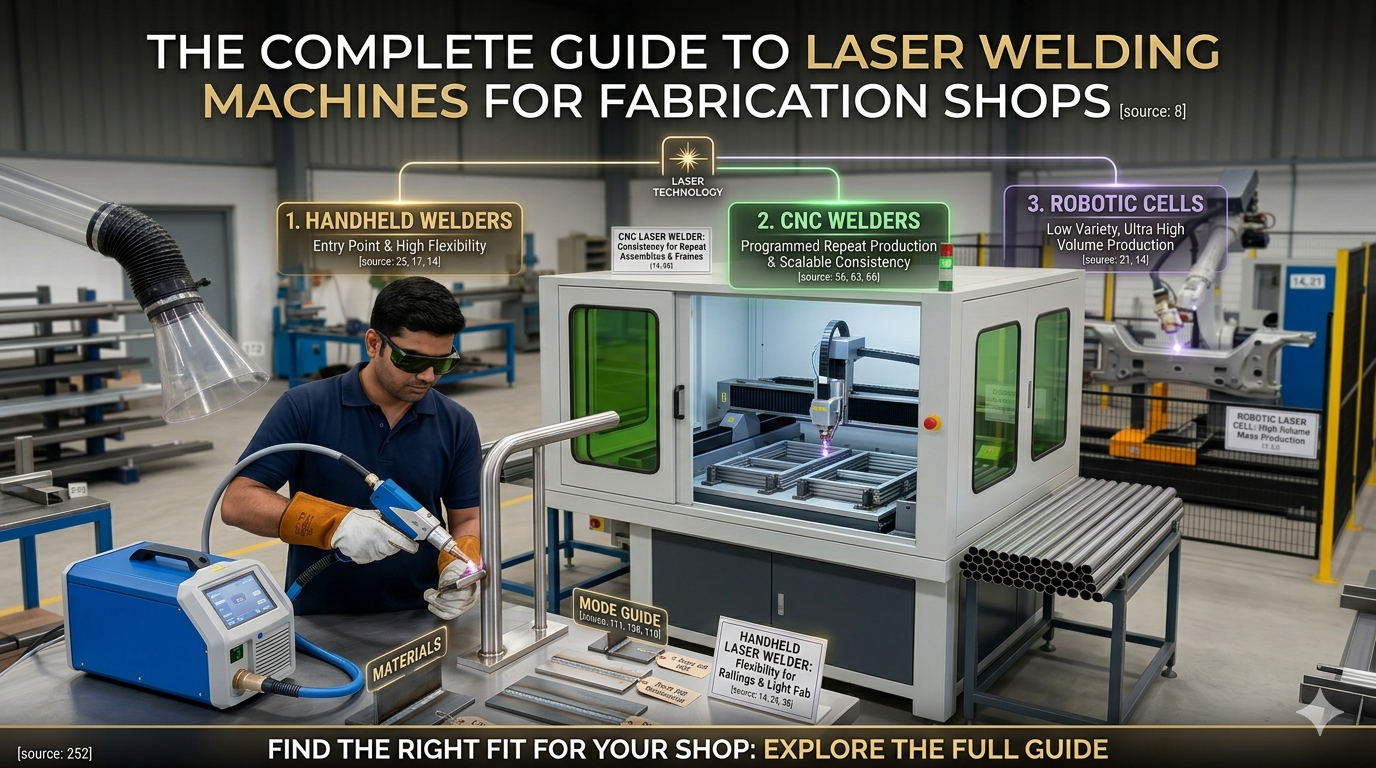
Laser Welding Machine for Metal Fabrication Shops
A Supporting Blog- Laser Cutting and Marking Machines for Construction…