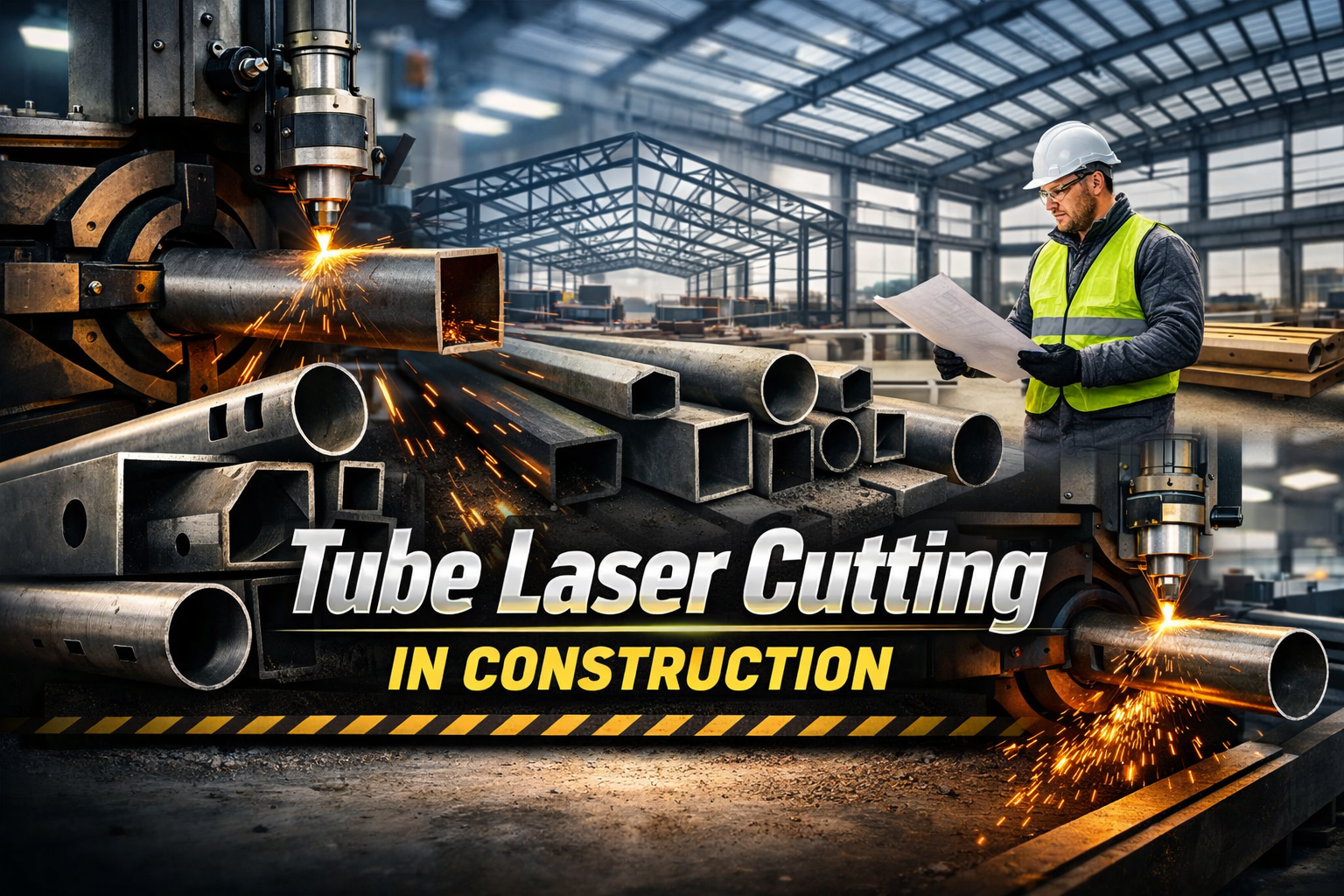
A Supporting Blog — Laser Cutting and Marking Machines for Construction
1. Introduction
Pre-engineered building fabrication is one of the most profile-intensive manufacturing processes in the construction sector — and profile cutting is its biggest production bottleneck.
A single PEB project for an industrial shed or warehouse may involve 200 to 500 structural members: columns, rafters, purlins, girts, eave struts, and bracing members. Each member needs to be cut to precise length, with accurate end profiles, connection holes, and cope details that allow it to fit together on site without shimming or adjustment. In a conventional PEB shop, producing these members involves a band saw, a drill press, an angle grinder, and a great deal of skilled operator time — for every single piece.
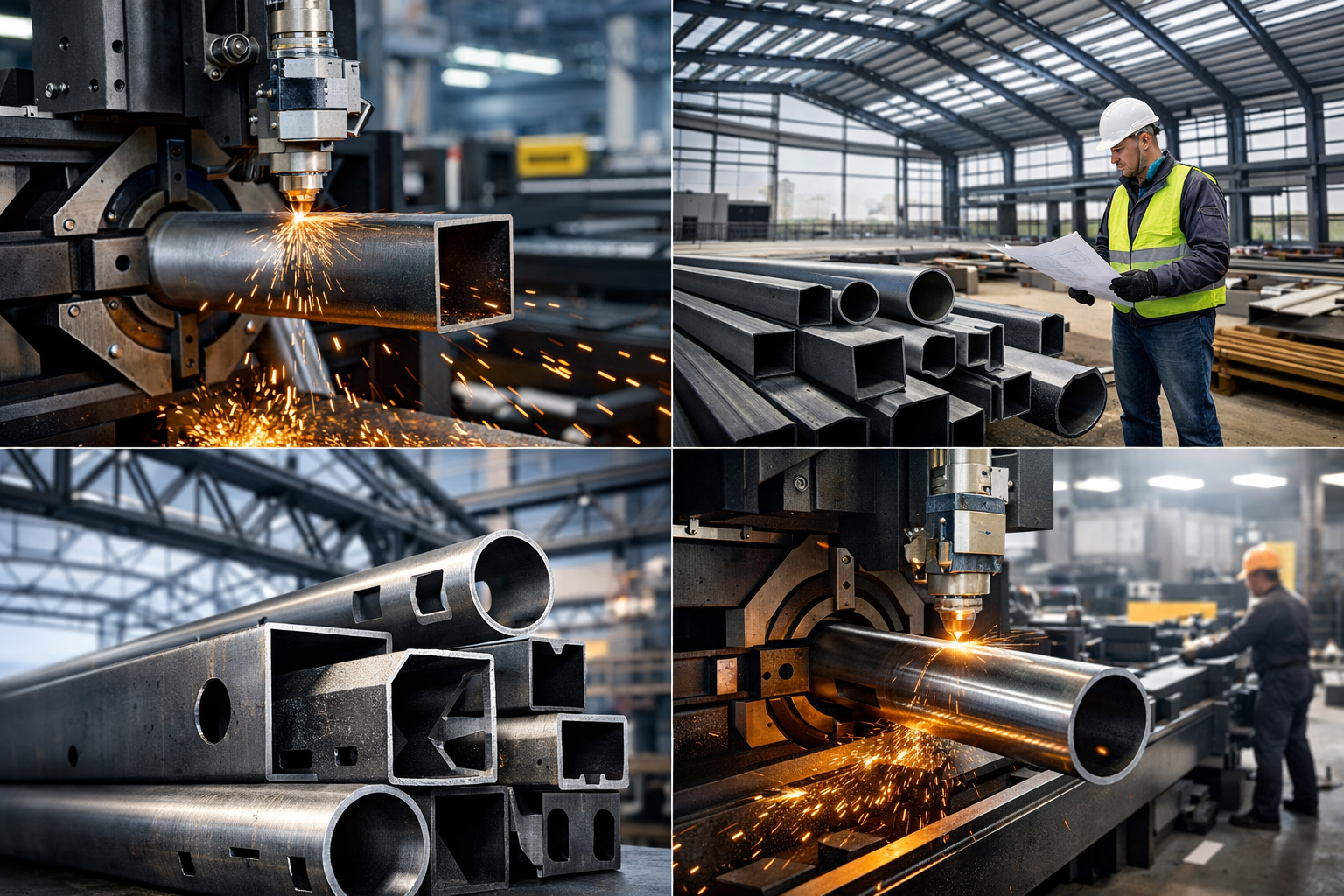
A tube laser cutting machine changes this entirely. It takes a structural profile — an RHS column, a C-section purlin, a round bracing rod — and produces all cuts, holes, end profiles, and cope details in a single automated operation, from a program derived directly from the structural drawing. What previously required four operations and 30 to 50 minutes per piece takes 3 to 8 minutes on a tube laser — and every piece in the batch is identical.
This guide is written for PEB manufacturers, structural steel fabricators, industrial shed builders, and construction contractors who process large volumes of structural profiles. It covers what a tube laser cutting machine does in a PEB environment specifically, the applications it serves, the specifications that matter, and the production and financial case for the investment.
This is a supporting article in the broader guide on laser technology for construction. For the full overview, read the Laser Cutting and Marking Machines for Construction — Pillar Blog.
2. What PEB Fabrication Actually Involves — And Where the Bottleneck Is
To understand why tube laser cutting delivers such significant gains in a PEB environment, it helps to map exactly what PEB fabrication involves and where the time goes.
The Structure of a PEB Project
A pre-engineered building is designed and manufactured in a factory as a kit of steel components that are shipped to site and erected. The structural system consists of:
- Primary framing: Portal frame columns and rafters — the main load-bearing members. Typically fabricated from built-up I-sections, RHS, or heavy hollow sections. Each primary frame member is unique to the building geometry.
- Secondary framing: Purlins, girts, and eave struts — the light gauge members that span between primary frames to support the roof and wall cladding. Typically C-sections or Z-sections, produced in large repetitive batches.
- Bracing: Diagonal bracing members — round rod, angle, or hollow section — that provide lateral stability to the structure.
- Connections: Bolted end plates, base plates, and gussets that connect primary and secondary members together and to the foundation.
The Volume Challenge
A medium-sized PEB project — a 50m x 100m industrial shed — might involve 20 primary frame portals, each with two columns and two rafter sections, plus 300 to 400 purlin and girt sections across the roof and walls, plus bracing members, eave struts, and connection components. The total number of structural members to be cut, drilled, and prepared can exceed 600 pieces for a single project.
Where Time Is Lost in a Conventional PEB Shop
In a conventional PEB fabrication shop without laser cutting, each structural member passes through multiple operations:
- Manual layout: marking cut lines, hole centres, and end profiles on each member
- Band saw or plasma cutting: cutting to length and producing end profiles
- Drill press: producing connection holes — multiple setups per member for holes on different faces
- Grinding: dressing cut ends, removing burrs, preparing surfaces for welding
- Fitting and checking: verifying that the finished member matches the drawing before it moves to welding
For a primary frame rafter with a mitre cut at the ridge, a haunch connection profile at the column, and 12 purlin cleat holes along its length, this conventional process takes 35 to 50 minutes per piece. For a 600-piece project, that is 350 to 500 hours of profile preparation time — before a single weld is made.
How These Bottlenecks Compound
Profile preparation is the first stage in the PEB production flow. If it is slow, everything downstream — welding, assembly, painting, and dispatch — is also delayed. A conventional PEB shop running at manual profile preparation speed cannot accelerate delivery by adding more welders, because the welding station is waiting for prepared members.
Watch Out: In a conventional PEB shop, the profile preparation bottleneck limits the entire factory’s output — not just the cutting department. Removing this bottleneck with a tube laser machine unlocks throughput across the entire production line.
3. How a Tube Laser Cutting Machine Works in a PEB Production Environment
A tube laser cutting machine designed for PEB production is not simply a laser cutter — it is an integrated profile processing system that replaces four to five conventional operations with one.
Loading and Chucking
The structural profile — a 6m or 9m RHS column, a C-section purlin, a round bracing rod — is loaded into the machine’s chuck system. A dual-chuck machine holds the profile at both ends, providing stability along its full length. For high-volume secondary member production, a bundle loader automatically feeds the next profile from a stack as each one is completed, allowing continuous production without manual loading between pieces.
The Range of Operations in a Single Pass
Once the profile is loaded and the cutting program is running, the machine performs all required operations without repositioning or operator intervention:
- Length cutting to precise dimension from the structural drawing
- Mitre cuts at any programmed angle — ridge cuts, connection angles, compound mitres
- Cope cuts where one profile meets another at a curved or profiled intersection
- Connection holes and bolt holes on any face of the profile
- Slots for clip angles, cleats, and ancillary connections
- Saddle profiles for round-to-round connections in bracing assemblies
- Notches and weld preparation details at connection points
CNC Programming from Structural CAD Drawings
The cutting program is generated directly from the structural detailing drawing — in DXF, STEP, or STP format — imported into the machine’s CAM software. The software automatically generates the cutting sequence, rotation schedule, and repositioning moves. The operator reviews the simulation, confirms the program, and starts the machine. No manual marking, no scribe lines, no templates.
Bundle Loading for High-Volume Secondary Member Production
For secondary members — purlins and girts produced in batches of 50 to 200 identical pieces — bundle loading is the feature that makes the productivity numbers possible. The operator loads a bundle of C-section or Z-section stock at the start of the batch. The machine automatically feeds, chucks, cuts, and ejects each piece continuously until the bundle is exhausted. Operator intervention is needed only to reload the bundle and collect finished parts.
Key Insight: On a bundle of 100 C-section purlins with standard end coping and sag rod holes, a tube laser machine with bundle loading processes the entire batch in under two hours. The same batch takes a conventional shop 13 to 20 hours across band saw, drill press, and grinding operations.
4. Specific Applications — Primary Framing Members
Primary framing members are the most geometrically complex components in a PEB structure — and the ones where tube laser cutting delivers the most dramatic reduction in processing time per piece.
Columns
A portal frame column in a PEB structure typically requires a square base cut for the base plate connection, a series of base plate anchor bolt holes, a slotted or profiled top end for the haunch or knee brace connection, and splice holes if the column is delivered in two sections. In a conventional shop, these operations require three or four separate setups across different machines. On a tube laser, all operations are programmed into a single run — the column enters raw and exits fully prepared.
Rafters
A primary rafter spans from column to column across the building width. It typically requires a mitre cut at the ridge where it meets the opposing rafter, a haunch connection profile at the column end, purlin cleat holes at regular intervals along its length, and possibly splice holes if the rafter is too long to transport in one piece. The variation in rafter geometry between portal frames means each piece may be unique — laser cutting handles this as easily as repetitive production.
Haunch and Knee Brace Members
Haunches and knee braces are short members with compound angle cuts at both ends — the most challenging cuts to produce accurately by manual methods. The angle varies with the building geometry and must be produced to within fractions of a degree for the connection to assemble correctly. A tube laser machine cuts these angles from the programmed geometry without any manual interpretation or operator skill dependency.
Time Comparison: Tube Laser vs Conventional Process
For a primary rafter with a ridge mitre, haunch end profile, and 14 purlin holes:
- Conventional process: Manual layout 10 min + band saw cut 15 min + drill press 20 min + grinding 10 min = 55 minutes per piece
- Tube laser: Program load 2 min + cutting cycle 5–8 min = 7–10 minutes per piece
- Saving: 80–85% reduction in processing time per primary frame member
Pro Tip: For a PEB project with 40 primary rafter sections, tube laser cutting saves approximately 37–40 hours of profile preparation time on rafters alone — before counting savings on columns, purlins, and bracing.
5. Specific Applications — Secondary Framing Members
Secondary framing members — purlins, girts, and eave struts — are where the volume of a PEB project is concentrated, and where tube laser cutting delivers its highest total time saving per project.
Purlins
Purlins span between primary frames to support the roof sheeting. They are typically C-section or Z-section light gauge members, produced in large repetitive batches of identical length and end profile. Each purlin needs an end cope (to fit against the primary rafter flange), sag rod holes at mid-span, and sometimes clip angle connection holes at each end.
In a conventional shop, purlin preparation involves: cutting to length on a band saw or guillotine, coping the ends with a grinder or notching tool, and drilling sag rod and connection holes on a drill press. For a batch of 100 purlins, this is a full day’s work for two operators.
On a tube laser machine with bundle loading, the same batch of 100 purlins — with all coping and holes — is processed in under two hours by one operator.
Girts
Wall girts span between columns to support the wall cladding. They carry similar end profile and connection hole requirements to purlins, and are similarly produced in large repetitive batches. The productivity gain on girts is equivalent to that on purlins — the tube laser machine processes a full batch while an operator monitors and manages material flow.
Eave Struts
Eave struts run along the eave of the building, connecting the top of the wall girt system to the base of the roof purlin system. They have a more complex cross-section than standard purlins and carry end connection details that must be precise for the cladding system to fit correctly. Laser cutting produces these end details consistently across the full batch.
Bracing Members
Round rod bracing, angle bracing, and hollow section bracing members need to be cut to precise lengths with clean, square ends. Round rod also requires end preparation for threading or swage fittings. A tube laser machine with rotary capability handles round rod bracing cleanly, cutting and preparing both ends in a single operation.
Key Insight: Secondary member production is where the payback calculation for a tube laser machine is most compelling. The volume is high, the operations are repetitive, and the time saving per piece accumulates rapidly across a project batch.
6. Specific Applications — Construction Frames and Structural Assemblies
Beyond PEB manufacturing, tube laser cutting serves the broader construction fabrication market — custom structural assemblies, industrial buildings, and commercial construction where profiles are fabricated to project-specific designs rather than a standard PEB catalogue.
Industrial Shed and Warehouse Steel Frames
Custom-fabricated steel frames for industrial buildings involve many of the same profile types as PEB work — hollow section columns, I-beam rafters, bracing members — but in non-standard configurations that are designed for each project. Tube laser cutting handles custom work as efficiently as repetitive PEB production, because the cutting program is derived from the CAD drawing for each piece regardless of whether it is one of a kind or one of a hundred.
Mezzanine Floor Structures
Mezzanine floors require beams, columns, and connection brackets fabricated from hollow section steel. Beam notching — where the beam end is cut to fit into or around a column — is one of the most difficult operations to produce consistently by manual methods. A tube laser machine programs and produces these notched ends accurately from the drawing, ensuring the mezzanine assembly fits together without adjustment.
Staircase and Railing Structures
Industrial building staircases and internal railing systems are fabricated from structural hollow sections and round tube. The connection details — cope joints, saddle cuts, mitre ends — that make railing fabrication time-consuming by manual methods are single-operation cuts on a tube laser machine. For a construction fabricator handling both PEB production and internal building fit-out, the same machine serves both.
For a detailed look at tube laser cutting applications in railing and frame fabrication, read Why Tube Laser Cutting Is Useful for Construction Frames and Railings.
7. How Tube Laser Cutting Improves Weld Quality and Assembly Speed
The benefit of tube laser cutting does not stop at the cutting station. The quality of the cut directly affects the speed and quality of every downstream operation — welding, assembly, and site erection.
Why Fit-Up Quality Determines Weld Quality
When a laser-cut end meets the mating surface at a joint, the fit is tight and consistent — typically within 0.1mm of the programmed geometry. This means the weld gap is minimal, the weld pool does not have to fill a large gap, and the welder can complete the joint in a single pass at the correct parameters. The result is a stronger, more consistent weld with less heat input and less distortion.
When a manually cut or plasma-cut end meets its mating surface, the fit may vary by 1mm to 3mm depending on the consistency of the cutting operator. This gap must be filled with weld material, requiring more passes, more heat, and more time. On a large PEB project with hundreds of welded connections, this weld quality and speed difference compounds into a significant production advantage.
Faster Assembly and Less Site Adjustment
PEB erection speed on site depends on members fitting together as the drawing says they should. When laser-cut members are dimensionally consistent to the programmed specification, the erection crew installs them without shimming, forcing, or adjusting connections. When manually cut members vary in length or end profile, the erection crew spends time making up the difference — which adds cost and slows the critical-path activity of getting the structure up.
Fewer Weld Failures on Inspected Structural Joints
Structural welds on primary PEB frame connections are often subject to visual inspection and sometimes non-destructive testing. A weld made on a laser-cut joint — with tight fit-up, correct gap, and single-pass execution — passes inspection consistently. A weld made on a poorly-fitted joint is more likely to have voids, undercut, or lack of fusion — and more likely to require repair, which is significantly more expensive than getting it right the first time.
For a full explanation of how laser welding complements laser cutting in a high-quality fabrication workflow, read How Laser Welding Supports Strong and Clean Metal Fabrication.
8. Marking and Traceability for PEB Components
A PEB project delivers hundreds of structural members to a construction site, where an erection crew must identify each piece, locate its position in the erection drawing, and install it in the correct sequence. Without reliable marking, this process is slow, error-prone, and expensive.
Why PEB Components Must Be Identified
PEB erection drawings show each structural member with a unique mark — a component ID that identifies its type, location, and installation sequence. If the physical component does not carry a clear, readable mark that corresponds to the drawing, the erection crew must measure and compare each piece against the drawing to identify it — a slow and unreliable process on a large project.
Paint stick marks and adhesive labels — the most common marking methods in conventional PEB shops — are unreliable in the field. Paint marks fade or are obscured by primer. Labels peel off during transport and handling. By the time a batch of 300 purlins reaches the erection site, it may be impossible to identify which piece is which without remeasuring every one.
How Laser Marking Solves This
A laser marking machine applies component IDs, erection marks, and project references directly to the metal surface of each structural member — permanently, in a format that survives painting, transport, and site handling. The mark can be a human-readable alphanumeric code, a barcode, or a QR code that links to the erection drawing for that specific member.
For round bracing members and cylindrical components, rotary laser marking wraps the mark around the surface — ensuring it is readable regardless of how the member is oriented when the erection crew picks it up.
QR Codes and Digital Erection Management
Advanced PEB projects use QR codes on structural members to link each physical component to its digital record — the erection position, the material certificate, the inspection status. The site supervisor scans a member with a mobile device and immediately sees where it goes and whether it has been signed off for installation. This reduces erection errors and provides the project client with a complete digital audit trail of the structure.
For a full guide to laser marking for traceability in construction fabrication — including marking standards, QR code systems, and nameplate marking — read Laser Marking for Construction Parts: Why Traceability Matters.
9. Machine Specifications for PEB Fabrication — What to Look For
PEB fabrication places specific demands on a tube laser cutting machine that go beyond the specifications needed for light railing or frame work. Here is what matters for a PEB production environment.
| Member Type | Typical Profile | Wall Thickness | Key Operations | Laser Power Needed |
| Primary Column | SHS / RHS 200–300mm | 8–14mm | End cut, base holes, splice holes | 6kW – 9kW |
| Primary Rafter | I-beam / RHS | 6–12mm | Mitre, haunch profile, purlin holes | 4kW – 9kW |
| Haunch Member | RHS / Plate built-up | 6–10mm | Compound angle cuts, bolt holes | 4kW – 6kW |
| Purlin (C/Z) | C-section / Z-section | 1.5–4mm | Length cut, end cope, sag rod holes | 2kW – 4kW |
| Girt | C-section / RHS | 2–6mm | End profile, connection holes, lapping | 2kW – 4kW |
| Eave Strut | C-section / RHS | 3–6mm | End cuts, clip connection details | 2kW – 4kW |
| Bracing (Rod) | Round bar / pipe | 4–10mm | Length cut, threaded end prep | 3kW – 6kW |
| Knee Brace | RHS / SHS | 5–8mm | Compound mitre, end plate holes | 3kW – 6kW |
Maximum Profile Diameter and Loading Length
PEB primary frame members in large industrial buildings may include RHS sections up to 300mm x 300mm or larger. A machine rated to 350mm diameter covers the full range of standard PEB hollow sections. For loading length, most PEB fabricators process 6m and 9m stock — confirm that the machine’s loading system handles both lengths without requiring the operator to cut stock to shorter lengths before loading.
Laser Power for PEB Work
PEB primary members with wall thicknesses up to 12mm–14mm require 6kW to 9kW of laser power for clean cutting at production speed. Secondary members in light gauge C and Z section (1.5mm to 4mm wall) can be cut at 2kW to 4kW with very fast cycle times. If your PEB production includes both primary and secondary members — which most shops process — a machine in the 4kW to 6kW range covers secondary members efficiently and primary members adequately, with 6kW to 9kW needed for the heaviest primary sections.
Dual Chuck — Non-Negotiable for Primary Frame Members
Primary frame members in RHS 200x200mm and above, at lengths of 6m to 9m, are heavy and subject to vibration on a single-chuck machine. This vibration causes positional error on holes and cut profiles, which creates fit-up problems at the welding station. A dual-chuck machine supports the member at both ends throughout the cutting cycle, eliminating vibration and maintaining positional accuracy across the full member length.
Bundle Loading for Secondary Member Volume
For a PEB shop producing batches of 100 to 400 purlins and girts per project, bundle loading is the feature that makes the throughput numbers in Section 10 possible. Without bundle loading, an operator manually loads each profile between cuts — doubling the effective cycle time and halving the real-world throughput.
For a complete guide to tube laser machine specifications covering all buying criteria in detail, read How to Select a Tube Laser Cutting Machine for Construction Fabrication.
10. Production Throughput — What Numbers to Expect
The throughput numbers for a tube laser machine in a PEB production environment are the most compelling argument for the investment — and they deserve to be stated clearly, with realistic figures rather than best-case marketing claims.
| Operation | Conventional Method | Tube Laser Machine | Time Saving |
| Purlin length cut + end cope | 8–12 min per piece | 45–90 sec per piece | 80–85% reduction |
| RHS column: cut + drill holes | 25–40 min per piece | 3–6 min per piece | 75–85% reduction |
| Rafter: mitre + purlin holes | 30–50 min per piece | 4–8 min per piece | 80–85% reduction |
| Round bracing: cut + end prep | 10–15 min per piece | 1–2 min per piece | 85–90% reduction |
| Haunch member: compound cuts | 45–60 min per piece | 5–10 min per piece | 80–90% reduction |
| Secondary batch (100 purlins) | 13–20 hours | 1.5–2.5 hours | 85–90% reduction |
How Batch Size Affects Throughput
The cycle time figures above apply once the machine is running on a batch. Setup time — loading the cutting program, setting up the chuck jaws for a new profile size, loading the first bundle — is a fixed cost that is amortised across the batch. For a batch of 100 identical purlins, setup time is a small fraction of total cycle time. For a batch of one unique primary frame member, setup time is a larger proportion. Plan your production schedule to maximise batch sizes for secondary members.
Labour Saving in Real Terms
A conventional PEB shop processing 80 profiles per shift (a realistic figure for a busy manual operation) requires 6 to 8 skilled operators across cutting, drilling, and grinding operations. A tube laser machine processing 200 to 300 secondary members per shift with bundle loading requires 2 to 3 operators to manage material flow, program loading, and quality checks. The labour saving on profile preparation alone — typically 4 to 6 operators per shift — funds a significant portion of the machine’s operating cost.
How to Estimate Machine Requirements for Your Volume
Divide your required daily profile output by the realistic throughput per shift for your profile mix. A shop needing to process 500 secondary members per day on a two-shift operation needs 250 per shift. A tube laser machine with bundle loading processing 200 to 300 secondary members per shift covers this requirement on a single machine. For mixed primary and secondary production, model the two member types separately and sum the shift requirements.
Pro Tip: Run this calculation before your supplier meeting: total profiles per project ÷ machine throughput per shift = shifts required per project. Compare this to your current labour-hours per project for the same work. The difference is the productivity case for the machine.
11. Total Cost of Ownership for PEB Fabricators
The financial case for a tube laser cutting machine in a PEB fabrication shop is straightforward to model — because the costs it replaces are large, specific, and measurable.
| Cost / Benefit Factor | With Tube Laser Machine | Without Tube Laser Machine |
| Profile prep labour per shift | 2–3 operators | 6–10 operators |
| Profiles processed per shift | 150–300+ pieces | 40–80 pieces |
| Post-processing (grinding etc) | Minimal / none | 1–2 hrs per operator per shift |
| Rework from poor fit-up | Very low | Common — 5–10% of output |
| Project delivery speed | Faster — less bottleneck | Slower — profile prep limits throughput |
| Site erection speed | Faster — parts fit first time | Slower — shimming and adjustment needed |
| Machine payback period | Typically 18–36 months | N/A — ongoing labour cost |
Building the ROI Case
The monthly labour saving on profile preparation is the largest input in the ROI calculation. A PEB shop replacing 5 operators at an all-in cost of INR 25,000 per operator per month saves INR 1,25,000 per month in direct labour — INR 15,00,000 per year. At this saving rate, a tube laser machine in the INR 30,00,000 to INR 60,00,000 purchase price range pays back in 24 to 48 months from labour saving alone, before counting material waste reduction, throughput increase, and quality improvement.
Throughput Value: More Projects from the Same Factory
The hidden ROI item that is hardest to quantify but often largest in value is throughput. A PEB shop that can process profile preparation three to four times faster can take on three to four times the project volume from the same factory floor and workforce — or deliver the same volume in a third of the time, opening capacity for new contracts. This throughput value frequently exceeds the direct labour saving in the first year of machine operation.
How to Present the ROI Case
For management or investor approval, structure the case in three numbers: the monthly cost saving (labour + grinding consumables + rework reduction), the monthly revenue gain from throughput increase (additional project capacity at your margin), and the monthly machine cost (depreciation or lease payment + operating cost). If the first two exceed the third, the machine is self-funding from month one.
Pro Tip: Ask your supplier to model the ROI calculation for your specific production profile — volume per month, member mix, current labour cost. A supplier confident in their machine’s productivity will produce this model without hesitation.
12. Conclusion
For PEB manufacturers and construction fabricators processing significant volumes of structural profiles, a tube laser cutting machine is not a productivity improvement — it is a production transformation.
The operations that currently absorb the most time and labour in a PEB shop — manual layout, multi-step cutting, drilling, and grinding of hundreds of profile members per project — are replaced by a single automated process that produces better quality in a fraction of the time. The downstream effects — better weld fit-up, faster assembly, more consistent site erection — multiply the initial benefit across the entire project lifecycle.
The financial case is equally clear. The labour saving on profile preparation alone funds the machine cost within two to three years in most PEB production environments. The throughput increase — the ability to take on more project volume from the same factory — adds a revenue dimension to the ROI that makes the investment case stronger still.
For any PEB or construction fabricator currently processing more than 50 structural profiles per shift by manual methods, the question is not whether a tube laser cutting machine delivers a return — it is how quickly.
Related Posts
Laser Marking Machine for Rotary and Name Plates in Construction Fabrication
A Supporting Blog — Laser Cutting and Marking Machines for…
Cooker Cutting Laser Machine for Kitchenware Manufacturers
A Supporting Blog — Laser Cutting and Marking Machines for…
Laser Welding Machine for Metal Fabrication Shops
A Supporting Blog- Laser Cutting and Marking Machines for Construction…