
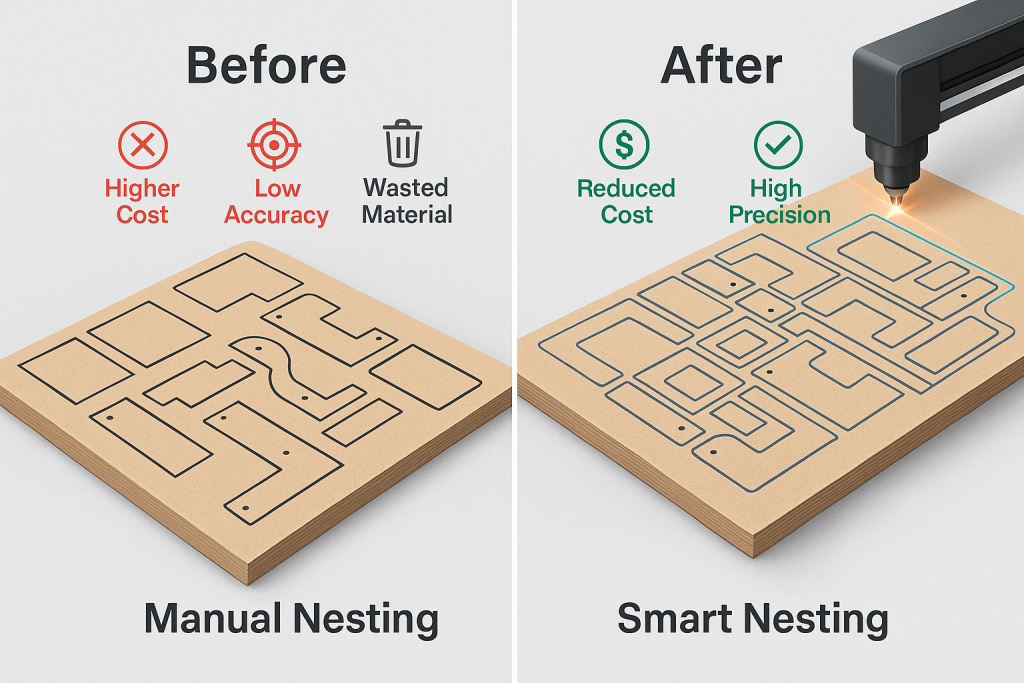
Smart nesting in furniture manufacturing is more than a technical upgrade—it’s a transformative approach . As raw material prices climb and the demand for customized, high-quality furniture grows, manufacturers are turning to digital solutions to remain competitive. One of the most powerful tools in this shift is smart nesting, especially when paired with high-precision laser cutting.
What is Smart Nesting in Manufacturing?
Nesting is the activity of positioning parts or designs onto raw material sheets to optimize utilization and reduce scrap. While traditional (manual) nesting relies on human judgment, smart nesting leverages advanced software algorithms to automate and optimize layouts. For industries like furniture manufacturing, where sheet materials like MDF, plywood, or veneer are common, this shift dramatically improves efficiency.
How Does Smart Nesting Work in Furniture Manufacturing?
Smart nesting software plays a pivotal role in modern furniture manufacturing by analyzing CAD/CAM design files. It evaluates several parameters like part geometry, optimal orientation, kerf width, and material grain direction to reduce waste and maximize material. Unlike manual layout planning, which is time-consuming and prone to human error, smart nesting delivers consistent, optimized results within seconds.
The software then integrates with high-precision laser cutting machines to carry out the layout with complete ease. These machines translate digital instructions into clean, accurate cuts with minimal variation. By synchronizing software intelligence with laser precision, manufacturers achieve superior cut quality, reduce rework, and significantly enhance production speed. This coordinated process not only saves time but also lowers production costs, making it an essential for cost-effective furniture making.
Benefits of Smart Nesting for Furniture Makers
- Maximized Material Utilization: By fitting more parts onto a single sheet, waste is drastically reduced.
- Reduced Production Cost: Less material use and fewer reworks lead to significant savings.
- Improved Cutting Accuracy: High-precision laser cutting delivers flawless results, reducing the need for finishing.
- Faster Turnaround Time: Optimized layouts allow machines to work faster and smarter.
- Eco-Friendly Manufacturing: Smart nesting supports sustainability by minimizing offcuts and reducing energy use.
Real-World Applications in Furniture Manufacturing
Smart nesting is widely used in various stages of furniture manufacturing where efficiency and accuracy are paramount:
- Cutting MDF boards for modular furniture units, where standard dimensions need to be maintained with minimal waste.
- Designing decorative wall panels and intricate geometric patterns, especially for customized furniture or aesthetic installations that demand precision and detail.
- Managing mixed-material layouts that involve combining wood with laminates, veneers, or even metal inserts in a single sheet, reducing handling time and increasing consistency.
Key Components Driving Smart Nesting Efficiency
- Smart nesting software: This is the core of modern layout optimization. It analyzes hundreds of parts and determines the most efficient placement on sheet material, accounting for shapes, sizes, and grain orientation.
- High-precision laser cutting machines: Once the layout is finalized, laser machines carry out the cutting process with extreme accuracy, minimizing human error and ensuring smooth, clean edges.
- Synchronized execution: The nesting software communicates directly with the laser system, allowing real-time instruction and adjustment, ensuring each cut is made exactly as designed.
- Micron-level accuracy: This synchronization results in a cutting process that can achieve tolerances within microns, which is especially useful in high-end furniture production where fit and finish are critical.
- Scalability and speed: Together, these tools allow manufacturers to process high volumes of parts quickly, without compromising quality or wasting material.
- Machine-software compatibility: It is vital to ensure that the software used is compatible with your cutting hardware to unlock the full benefits of smart nesting. Proper integration streamlines workflow, boosts output, and reduces downtime.
Together, these elements make smart cutting solutions for cost-effective furniture making a practical and profitable reality.
Common Mistakes to Avoid in Nesting
- Using generic instead of material-specific settings: Different materials respond uniquely to laser cutting. Failing to adjust parameters like speed, power, and kerf width for MDF versus plywood can result in subpar cuts, excessive burning, or wasted material.
- Ignoring part orientation or kerf compensation: Overlooking how parts are aligned with the material grain or neglecting to compensate for kerf width can lead to misfits, weakened joints, and inaccurate assembly.
- Relying on outdated manual nesting methods: Manual layout planning is time-consuming, inconsistent, and inefficient compared to automated nesting software that evaluates thousands of permutations instantly.
- Cramming too many parts without considering cut order or spacing: Overpacking a sheet might seem efficient but can lead to overheating, burn marks, and reduced cut quality due to inadequate spacing or improper cut sequencing.
Getting Started: How Furniture Makers Can Adopt Smart Nesting
- Evaluate your current material waste and cutting precision.
- Select nesting software that fits your production volume and materials.
- Update or synchronize with a compatible laser cutting system.
- Train your team on best practices in digital layout optimization.
Conclusion
Smart nesting in furniture manufacturing offers a clear path toward cost-effective, precise, and sustainable production. By integrating smart cutting solutions for cost-effective furniture making, manufacturers can stay competitive in an evolving market.
Contact us for a live demo. Explore our laser solutions for furniture manufacturers
Related Posts

SLTL Group Laser Cutting Machines: Precision, Power & Innovation from India to the World
Introduction In the fast-evolving world of metal fabrication, laser cutting…
Why Are Top Kitchenware Brands Turning to Laser Technology?
The utensil manufacturing industry has undergone a massive transformation in…
Laser Technology: The Secret Behind Modern Kitchen Tools
The kitchenware industry is rapidly embracing advanced technologies to meet…