
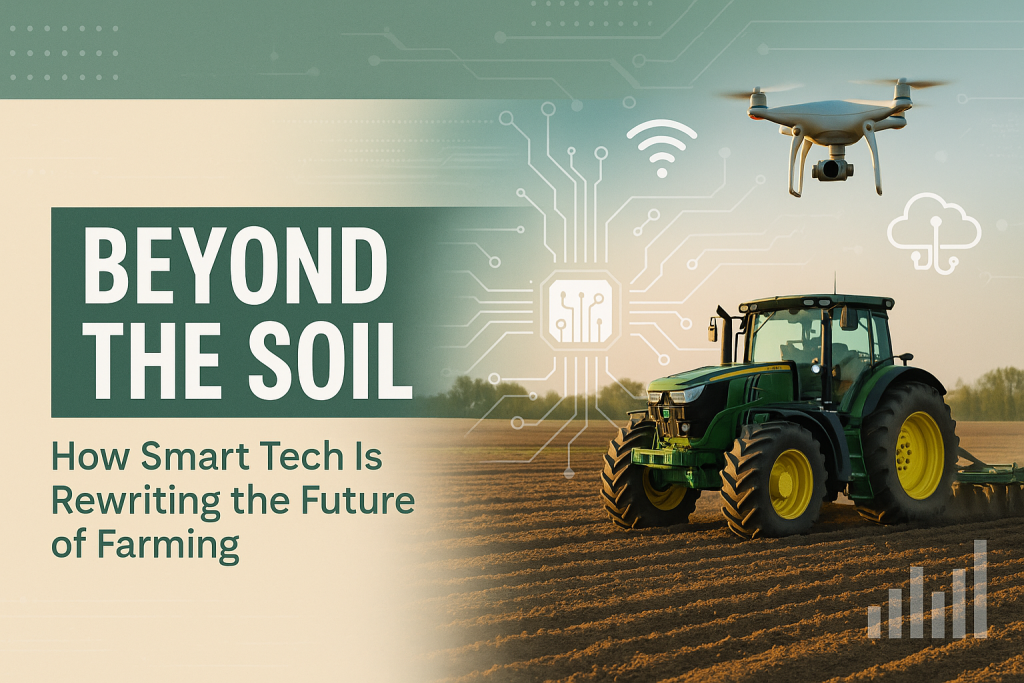
Agriculture is entering a new era one that’s not defined by just tractors and seeds, but by sensors, satellites, and software. Welcome to smart farming, a powerful blend of agriculture and technology that is transforming the way food is grown, managed, and delivered.
No longer relying purely on manual methods or intuition, today’s farmers are turning into agri-technologists. With the help of smart equipment and real-time data, they are meeting growing demands, tackling climate challenges, and scaling operations with precision.
What is Smart Farming?
Smart farming, also known as precision agriculture, involves using cutting-edge technologies to enhance farming efficiency, productivity, and sustainability. It empowers farmers and agribusinesses to make data-driven decisions that:
- Reduce costs
- Maximize yields
- Save time and labor
- Protect natural resources
Why Smart Farming Matters
India faces crucial challenges in agriculture:
- Fragmented land holdings
- Erratic monsoons
- Labor shortages
- Resource overuse
Smart farming helps overcome these by providing accurate, scalable, and sustainable solutions to meet both company goals and national food security.
Core Technologies behind Smart Farming
- GPS and GIS Mapping
- Used in tractors and harvesters for accurate field mapping.
- Enables variable rate application of seeds and fertilizers.
- IoT-Based Soil and Climate Sensors
- Monitor soil pH, moisture, temperature, and nutrient levels.
- Help automate irrigation and fertilizer usage.
- Drones and UAVs
- Provide aerial crop imaging for plant health analysis.
- Used in precision spraying and field surveillance.
- Artificial Intelligence (AI) & Machine Learning (ML)
- Predict pest outbreaks, disease spread, and optimal harvesting times.
- Power real-time recommendations via mobile apps.
- Farm Management Software (FMS)
- Centralizes farm operations (inventory, sowing, harvest tracking).
- Supports forecasting, planning, and compliance.
Advanced Agricultural Equipment Empowering Farmers
Modern farmers use a wide variety of smart and semi-automated machines that make farming more precise, less labor-intensive, and highly productive.
Combine Harvesters
- Integrate reaping, threshing, and winnowing.
- Significantly reduce harvest time and labor.
Automatic Transplanters
- Used in crops like paddy and vegetables.
- Plant seedlings at uniform spacing and depth to improve efficiency.
Smart Sprayers
- Equipped with sensors and nozzles for targeted spraying.
- Reduce chemical usage and environmental impact.
Rotary Tillers and Cultivators
- Prepare the seedbed by breaking up soil clumps.
- Improve soil aeration and water infiltration.
Multi-Crop Planters
- Adjustable machines for planting a variety of crops.
- Save time and ensure precision in seed placement.
Silage Harvesters & Balers
- Turn forage crops into compacted silage bales for livestock feed.
- Essential for dairy and cattle farming.
Livestock Monitoring Equipment
- Includes sensors, collars, and tags.
- Track animal health, movement, feeding patterns, and milk yield.
Controlled Environment Agriculture (CEA) Tools
- Includes hydroponic systems, grow lights, and automated nutrient delivery.
- Used in greenhouses and indoor farms.
Grain Moisture Meters
- Portable tools that assess moisture content before storage.
- Prevent spoilage and maintain quality.
Smart Fertilizer Spreaders
- Use field data to apply fertilizer only where needed.
- Improve soil fertility and reduce cost.
Agricultural Robots (AgBots)
- Perform tasks like sowing, weeding, harvesting, and spraying.
- Operate autonomously or semi-autonomously.
Automated Weather Stations
- Installed on farms to capture local climate data.
- Connect with apps to guide real-time decisions.
Electric & Solar-Powered Mini Tractors
- Eco-friendly options for small and medium farms.
- Suitable for orchard maintenance and inter-row cultivation.
How Smart Farming Helps Agribusinesses Meet Their Needs
Smart farming helps agribusinesses meet their production, sustainability, and profitability goals by integrating advanced equipment into daily operations. Here’s how various machines play a critical role:
- Combine Harvesters: These all-in-one machines drastically reduce labor and time during harvesting by performing reaping, threshing, and winnowing in a single process. This leads to faster turnaround and consistent crop quality.
- Precision Planters and Seed Drills: Ensure uniform seed placement and depth, leading to even germination and optimal crop stand. This minimizes seed waste and enhances yield potential.
- Automatic Transplanters: Improve efficiency in paddy and vegetable cultivation by maintaining equal spacing, reducing the need for manual labor, and increasing planting accuracy.
- Rotary Tillers and Power Cultivators: Provide better soil aeration and bed preparation, ensuring healthy root development and water absorption.
- Smart Sprayers and Fertilizer Spreaders: These tools use sensors and field mapping data to apply chemicals or nutrients only where needed, cutting down input costs and improving plant health.
- Agri Drones: Offer aerial imaging to monitor crop health, detect pest or disease outbreaks early, and even perform targeted spraying over large fields.
- Agricultural Robots (AgBots): Automate repetitive tasks like weeding, sowing, and harvesting, making large-scale farming less labor-intensive and more productive.
- Controlled Environment Equipment: Such as automated hydroponic systems, climate controllers, and grow lights help agribusinesses cultivate high-value crops year-round.
- Post-Harvest Machinery: Equipment like threshers, graders, and moisture meters maintain product quality, reduce post-harvest losses, and ensure market readiness.
- Smart Tractors and Electric Implements: Offer real-time GPS tracking, data logging, and automation, helping reduce emissions while improving fuel efficiency and operational precision.
In summary, by equipping farms with smart machinery, agribusinesses can produce more with fewer inputs, meet global standards, reduce costs, and respond rapidly to market demands all while staying sustainable and competitive.
Future Outlook: Smarter, Greener, Scalable
The future of smart farming will see:
- 5G-enabled farming zones for real-time command.
- Block chain in agri-supply chains to ensure authenticity.
- Vertical farming and hydroponics in urban areas.
- Sustainable practices powered by carbon-tracking systems.
Smart farming is not a luxury, it’s a necessity. It is the bridge between traditional wisdom and modern demands. It ensures that farming is profitable, scalable, and sustainable.
Final Thoughts
As we prepare for a world with more mouths to feed and fewer resources, smart farming offers the blueprint for progress. Companies that invest in smart technologies today are not just improving crop yields they are building resilient, future-ready agricultural systems.
Smart farming isn’t about replacing farmers. It’s about empowering them with knowledge, with tools, and with a vision for a better tomorrow.
Related Posts
Top 10 Best Laser Marking Machine Manufacturers in the World (2026)
In modern industrial manufacturing, laser marking machines have become a…
How Fiber Laser Cutting is Revolutionising the Sheet Metal Industry
Introduction Sheet metal fabrication has always been the engine room…

Laser Marking Machine for Rotary and Name Plates in Construction Fabrication
A Supporting Blog — Laser Cutting and Marking Machines for…