
Laser Cutting and Marking Machines for Construction
How Laser Cutting Improves Construction and Structural Fabrication
A Complete Guide for Fabricators, Contractors and Machine Buyers
1. Introduction
Construction and structural fabrication have always demanded speed, strength, and precision — three qualities that traditional cutting tools struggle to deliver together.
No matter if you work with steel frame structures for a warehouse, cut tube sections for railing construction, mark parts for construction frames and components, the quality of the cutting and marking tools used by your team is crucial to completing projects successfully.
Laser cutting machines have emerged as one of the most innovative tools to make any modern metal fabrication shop productive, as well as profitable. While some prefer to use plasma cutters or even angle grinders, lasers provide microscopic precision, negligible distortion of metals due to heating, and versatility when it comes to different materials and profiles.
This comprehensive guide will answer all questions regarding laser cutting and marking technology: what it is, what makes it valuable in construction, what benefits it offers, and what to pay attention to when buying a laser machine. We cover how lasers fit into the workflow of construction fabricators and PEB manufacturers and what advantages they have over other solutions.
If you want to learn more on a specific topic related to laser cutting for construction, you’ll find useful resources on tube and profile laser cutting and laser welding and marking in construction in our library of articles.
2. The Role of Laser Cutting in Construction and Structural Fabrication
Structural fabrication is the process of cutting, shaping, joining, and assembling raw metal into finished structural components — beams, columns, trusses, brackets, frames, railings, and more.
Such parts make up the structure of buildings, bridges, industrial sheds, warehouses, pre-engineered buildings (PEB) and even public infrastructure. The success of each cutting or welding depends on whether the whole structure will be built safely and economically on site.
What Laser Cutting Brings to the Table
The laser cutter works by concentrating a powerful light source to melt and vaporize metal according to an established program. Such a cutting process produces edges that are:
• Precise — tolerances as low as ±0.1 mm
• Smooth — less burr, dross, or slag than from plasma and flame cutting processes
• Rapid — appropriate for mass production
• Conformable — CNC-operated, thus the same for every piece
• Diverse — able to handle mild steel, stainless steel, aluminum, among others.
In such a scenario, the builder would end up with few defective pieces, faster assembly at site and adherence to blueprints.
Where Laser Cutting Fits in the Construction Workflow
Laser cutting usually comes into play during the stage of handling the raw material. The steel sheets, plates, and tubes are delivered from the mill and fed into the laser cutter. The parts cut by the machine are then sent straight to the welding/assembly area, requiring no further grinding or deburring.
It’s a huge improvement over plasma cutting that nearly always involves additional post-cutting processing – increasing the labor costs and processing times for every load.
For a detailed comparison, see How Laser Cutting Boosts Construction Projects – an extensive discussion on the advantages gained in various construction processes.
3. Tube Laser Cutting for Construction Frames, Railings and PEB Structures
Flatbed laser cutting handles sheet and plate metal well. But construction fabrication is heavily dependent on structural profiles — square hollow sections, rectangular hollow sections, round pipes, I-beams, and C-channels.
Cutting these profiles accurately with traditional tools means multiple setups, manual marking, angle grinders, and a great deal of operator skill. The result is often inconsistent, slow, and difficult to scale.
What Tube Laser Cutting Does Differently
The tube laser cutting machine is specially made for processing long profiles.
The tube turns inside a chuck while the laser head travels along the length of the tube, cutting holes, slots, mitres, coping cuts, and intricate notches automatically.
The advantages in a fabrication shop setting are many:
• Long structural steel components for industrial structures may be cut accurately and precisely by laser within seconds.
• Tubular railings may be easily configured to suit your particular project design.
• The PEB (Pre-Engineered Building) companies may increase productivity and eliminate any laborious measuring.
• Bars and structural members that were once manually drilled and fitted may be cut precisely for easy assembly.
This topic is explored in detail in Why Tube Laser Cutting Is Useful for Construction Frames and Railings, which covers specific applications, machine configurations, and the time savings you can expect.
Tube Laser Cutting for PEB Manufacturing
Pre-engineered building manufacturers process very high volumes of repetitive structural profiles. A tube laser cutting machine can dramatically reduce production time per member, improve consistency across batches, and eliminate the bottleneck that manual drilling and cutting creates.
For PEB-specific guidance on machine selection and workflow integration, see Tube Laser Cutting Machine for PEB and Construction Fabricators.
4. Laser Cutting vs Traditional Cutting for Structural Metal Parts
Before investing in laser technology, most fabricators want to understand exactly how it compares to the methods they already use.
The most common alternatives in structural fabrication are plasma cutting, oxy-fuel (flame) cutting, and waterjet cutting. Each has its strengths, but the comparison reveals why laser cutting has become the preferred choice for precision metalwork.
Side-by-Side Comparison
| Factor | Laser Cutting | Plasma Cutting | Oxy-Fuel Cutting | Waterjet |
| Cut Precision | Very High | Medium | Low | High |
| Edge Quality | Clean, smooth | Rough, dross | Rough, slag | Good |
| Speed (thin metals) | Very Fast | Fast | Slow | Slow |
| Material Range | Wide | Metals only | Steel only | Very Wide |
| Heat Distortion | Minimal | Moderate | High | None |
| Operating Cost | Medium | Low | Low | High |
| Secondary Finishing | Rarely needed | Often needed | Always needed | Rarely needed |
What This Means for Construction Fabricators
For structural work involving mild steel up to 20mm thick, laser cutting consistently outperforms plasma and flame on edge quality and precision. For thicker structural sections, plasma cutting may still be the practical choice — but for everything that goes into frames, cladding supports, railings, brackets, and secondary steelwork, laser cutting delivers better quality at comparable or lower per-part cost when volume is factored in.
For a deeper analysis of how these methods affect overall project cost and quality, read Laser Cutting vs Traditional Cutting for Structural Metal Parts.
5. How Laser Welding Supports Strong and Clean Metal Fabrication
Cutting is only half the story in structural fabrication. Once parts are cut, they need to be joined — and the quality of the weld determines the structural integrity, appearance, and longevity of the finished assembly.
Laser welding is increasingly being used alongside laser cutting in modern fabrication shops. It uses a focused laser beam to fuse metal at the joint, creating a weld that is narrower, stronger, and far cleaner than conventional arc welding methods.
Why Laser Welding Matters in Construction
- The heat-affected zone (HAZ) is significantly smaller, which means less warping and distortion of structural members
- Weld seams are visually clean — important for exposed architectural metalwork and railings
- Welding speed is higher, which improves throughput in high-volume shops
- Laser welding is easily integrated with automation and robotic systems
For a full explanation of the technology and its applications in metal fabrication, read How Laser Welding Supports Strong and Clean Metal Fabrication.
Laser Welding vs MIG Welding
MIG (Metal Inert Gas) welding remains the dominant method in most construction fabrication shops because of its low equipment cost and operator familiarity. However, laser welding offers real advantages in specific scenarios: thin-gauge metals, visible welds, high-volume repeat assemblies, and applications where post-weld grinding is costly.
A full comparison — covering cost, strength, skill requirements, and use cases — is available in Laser Welding vs MIG Welding for Construction Metal Parts.
If you are evaluating whether to add laser welding capability to your shop, see Laser Welding Machine for Metal Fabrication Shops for guidance on machine selection and ROI.
6. Laser Marking for Construction Parts — Traceability, Nameplates and Rotary Marking
In construction and structural fabrication, a part is not just a physical object — it is a documented component with a history.
Engineers, inspectors, and quality teams need to know which batch of steel a beam came from, what specification it meets, and whether it has passed quality checks. This is especially critical for projects that are subject to structural audits, international building codes, or safety certifications.
Why Traceability Matters
Laser marking is the most reliable way to permanently mark metal parts with serial numbers, heat codes, part numbers, QR codes, and compliance symbols. Unlike ink stamps or adhesive labels, laser marks cannot be removed, do not fade, and remain readable even after painting, powder coating, or exposure to site conditions.
To understand why this matters in real construction projects, read Laser Marking for Construction Parts: Why Traceability Matters — which covers marking standards, audit requirements, and how laser marking compares to other identification methods.
Nameplate and Rotary Marking for Fabrication Shops
Beyond part coding, fabrication shops use laser marking machines to produce professional nameplates for equipment, machinery panels, and control boards. Rotary laser marking — where the part rotates on an axis fixture — allows cylindrical components such as pipes, shafts, and fasteners to be marked cleanly all the way around.
For a practical guide to both applications, see Name Plate and Rotary Laser Marking for Fabrication Shops.
If you are evaluating machine options for nameplate and rotary marking in a construction or OEM environment, read Laser Marking Machine for Rotary and Name Plates in Construction Fabrication.
7. Laser Cutting Beyond Construction — Kitchenware and Industrial Product Applications
One of the most practical advantages of laser cutting and marking machines is that the same equipment used in construction fabrication can serve adjacent manufacturing segments.
This matters for fabrication shops that handle mixed product lines, and for machinery distributors and buyers who want to assess total machine utilisation across different customer types.
Laser Cutting for Cooker and Kitchen Equipment Manufacturing
Cooker bodies, burner rings, oven panels, and exhaust hoods are manufactured from thin stainless steel and mild steel sheets. These components require clean cuts, precise hole patterns, and curved profiles — all of which laser cutting handles with ease.
Traditional press tools and shearing machines struggle with small-batch customisation and complex profiles. A flatbed laser cutting machine can switch from one kitchen product design to another in minutes, simply by loading a new cutting program.
This application is covered in detail in How Laser Cutting Helps Cooker and Kitchen Equipment Manufacturing and Cooker Cutting Laser Machine for Kitchenware Manufacturers.
Bottle and Industrial Product Laser Marking for Branding
Laser marking is widely used across industrial product manufacturing for branding, compliance marking, and anti-counterfeiting. Glass bottles, plastic containers, metal cans, and industrial components can all be marked with high-resolution logos, batch codes, and regulatory information using a laser marker with the appropriate wavelength.
For buyers evaluating laser marking for industrial product branding and compliance, read Bottle Laser Marking and Industrial Product Branding: What Buyers Should Know.
8. How to Choose the Right Laser Machine for Your Fabrication Needs
Buying a laser machine is a significant capital investment, and the wrong choice can result in a machine that is underutilised, underpowered, or unsuitable for the work your shop actually does.
The right approach is to start with your production requirements — materials, thicknesses, part profiles, batch sizes, and budget — and then match machine specifications to those requirements.
Key Buying Criteria
- Laser power (wattage): Higher wattage cuts thicker materials faster. For structural steel up to 12mm, 3kW–6kW is typical. For thicker plate, 8kW–12kW or higher is needed.
- Bed size: Flatbed machines come in standard sizes (1500x3000mm, 2000x4000mm, etc). Choose based on your largest sheet size.
- Tube capacity: For tube laser machines, check the maximum tube diameter, wall thickness, and length the machine can handle.
- Software and nesting: Good nesting software reduces material waste significantly. Check what CAD/CAM software is included or compatible.
- After-sales support: Laser machines require periodic servicing and consumable replacement. Verify local service availability before buying.
Flatbed vs Tube Laser — Which Do You Need?
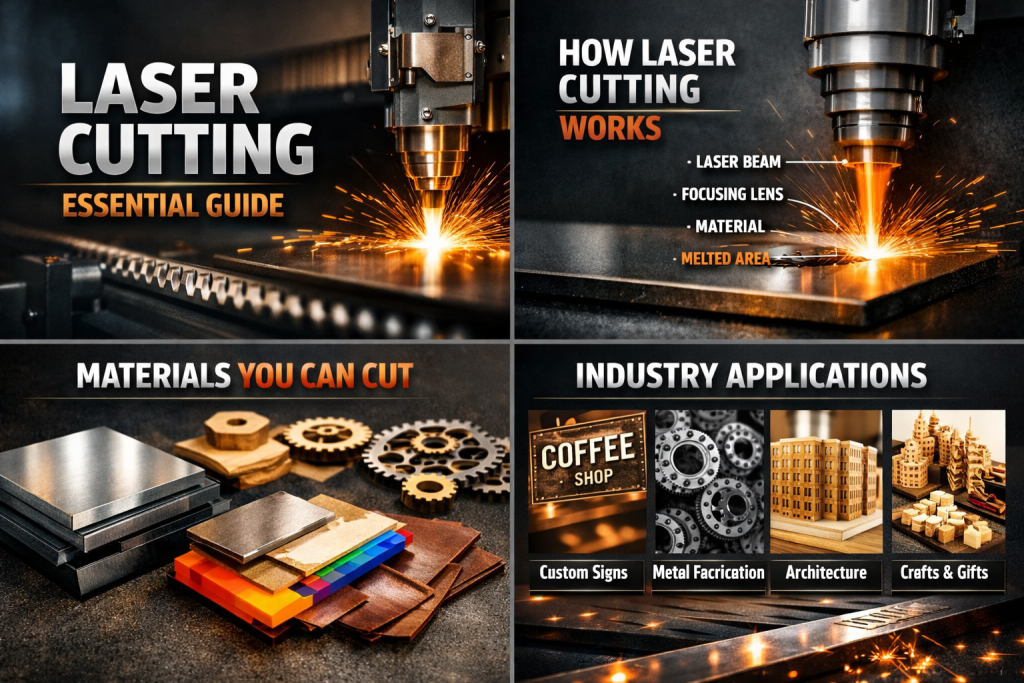
If your fabrication work is primarily sheet metal and plate (cladding, brackets, panels, floor plates), a flatbed laser cutter is the right choice. If your work involves structural profiles (pipes, hollow sections, beams), you need a tube laser or a combined flatbed-and-tube machine.
Many construction and PEB fabricators find that a tube laser machine gives them the highest ROI, because it replaces the most labour-intensive operations in their workflow.
For a full selection guide covering specifications, brands, and configurations, read How to Select a Tube Laser Cutting Machine for Construction Fabrication.
If you are comparing overall machine options for your shop, see Best Laser Cutting Machine for Construction Fabrication for a curated overview of machines suited to construction-grade work.
9. Summary: Laser Machines at a Glance
The table below summarises the key laser machine types covered in this guide, along with their primary use cases and industries served.
| Machine Type | Best For | Key Benefit | Industries Served |
| Flatbed Laser Cutter | Sheet metal, panels | High precision, clean edges | Construction, Kitchenware, Automotive |
| Tube Laser Cutter | Pipes, frames, railings, PEB | Complex profile cuts, no fixturing | Construction, PEB, Fabrication |
| Laser Welder | Joints, panels, frames | Strong, clean, low-distortion welds | Construction, Manufacturing |
| Laser Marker (Flat) | Parts, nameplates, serial codes | Permanent, high-contrast marking | Construction, Industrial OEM |
| Laser Marker (Rotary) | Cylinders, bottles, round parts | 360-degree precision marking | Industrial, Branding, FMCG |
10. Conclusion
Laser cutting and marking technology is no longer a luxury for large manufacturers — it is increasingly the standard for any fabrication shop that wants to compete on quality, speed, and cost.
For construction fabricators, the case is straightforward: laser machines cut faster, leave cleaner edges, require less post-processing, and produce more consistent parts than traditional methods. For PEB manufacturers and structural steel shops, tube laser cutting in particular represents one of the highest-return investments available today.
Laser welding adds another dimension — enabling stronger, cleaner joints on thin and medium-gauge steel without the distortion that arc welding produces. And laser marking ensures that every part your shop produces can be traced, certified, and identified for the lifetime of the structure it becomes part of.
Whether you are just beginning to evaluate laser technology or ready to specify a machine, the supporting articles linked throughout this guide will help you go deeper on the topics that matter most to your business.
Ready to explore further?
Start with How Laser Cutting Improves Construction and Structural Fabrication for a focused look at productivity gains, or jump to Best Laser Cutting Machine for Construction Fabrication if you are close to a buying decision. Our full library of guides covers every aspect of laser technology for construction — from tube cutting and welding to marking and branding.
Editor Note All text highlighted in yellow are planned supporting blog topics. Replace each highlighted phrase with a live hyperlink once the corresponding blog is published.
Related Posts
Top 10 Best Laser Marking Machine Manufacturers in the World (2026)
In modern industrial manufacturing, laser marking machines have become a…
How Fiber Laser Cutting is Revolutionising the Sheet Metal Industry
Introduction Sheet metal fabrication has always been the engine room…
Laser Marking Machine for Rotary and Name Plates in Construction Fabrication
A Supporting Blog — Laser Cutting and Marking Machines for…