
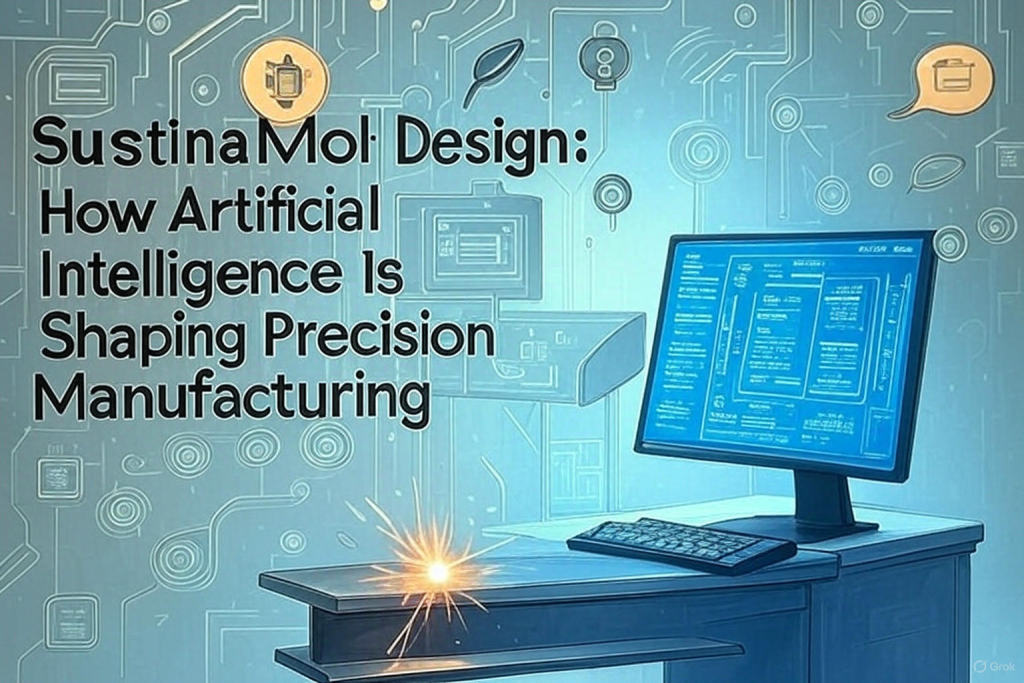
In precision manufacturing, where tolerances are measured in microns, mold design is both an art and a science. Molds are the backbone of industries producing everything from automotive parts to medical implants, shaping molten materials into the products we rely on daily. Traditionally, designing these molds has been a labor-intensive process, blending human expertise with iterative testing. But today, artificial intelligence (AI) is transforming this landscape, bringing unprecedented speed, accuracy, and innovation to mold design. In this blog, we’ll explore how AI is revolutionizing precision manufacturing, dive into its advanced applications, and consider its broader implications for the industry.
The Intricacies of Traditional Mold Design
Mold design is a complex puzzle. It requires creating tools that can withstand extreme temperatures and pressures while shaping materials like plastics, metals, or composites into flawless products. Designers must account for variables such as material flow dynamics, thermal expansion, cooling uniformity, part shrinkage, and mold durability- all while meeting tight deadlines and budget constraints.
Historically, this process depended on skilled engineers using computer-aided design (CAD) software, running finite element analysis (FEA) simulations, and relying on experience to anticipate real-world challenges. Despite their expertise, predicting material behavior under production conditions was often imprecise, leading to multiple prototypes, costly reworks, and extended lead times. Defects like weld lines, air traps, or uneven cooling could surface late, disrupting production and inflating costs. AI is now addressing these pain points with a data-driven, predictive approach that’s changing the mold design paradigm.
How AI Is Revolutionizing Mold Design
AI, powered by machine learning (ML), generative design, and advanced computational models, is streamlining mold design with remarkable efficiency. By analyzing vast datasets and optimizing processes in real time, AI is enabling manufacturers to create molds that are more precise, cost-effective, and sustainable. Here’s a deeper look at how AI is making an impact:
1. Generative Design for Innovative Solutions
Generative design, an AI-driven approach, redefines creativity in mold design. Engineers input specific parameters- material properties, production volumes, performance criteria, and cost limits- and AI algorithms produce thousands of design variations, each optimized for the given goals. These designs often feature complex, organic geometries that enhance performance in ways human designers might overlook.
For instance, in injection molding, AI can propose conformal cooling channels that follow the mold’s contours, ensuring uniform cooling and reducing cycle times by up to 30%. Such designs improve part quality by minimizing defects like warping or residual stress, while also boosting production throughput. Generative AI tools, like those integrated into platforms such as Siemens NX or Autodesk Fusion 360, are making these capabilities accessible across industries.
2. Predictive Simulations for Precision Engineering
AI’s predictive power is a cornerstone of its mold design revolution. Machine learning models, trained on extensive datasets of material behaviors, mold geometries, and production outcomes, can simulate mold performance with high fidelity. These simulations identify potential issues such as air entrapment, uneven material flow, or stress concentrations- faster and more accurately than traditional methods.
In plastic injection molding, AI can model the flow of molten polymers, predicting where defects like sink marks, voids, or knit lines might occur. By adjusting gate locations, runner systems, or mold cavity designs early, manufacturers can eliminate flaws before machining begins. This reduces the need for physical prototypes, slashing development timelines and costs. For high-precision industries like aerospace, where even minor imperfections are unacceptable, AI-driven simulations are proving transformative.
3. Cost and Sustainability Optimization
AI goes beyond performance to address economic and environmental concerns. By analyzing material usage, energy consumption, and lifecycle costs, AI optimizes mold designs to minimize waste and maximize efficiency. For example, it might recommend thinner mold inserts or low-impact materials that maintain structural integrity, reducing raw material costs and environmental footprint.
Sustainability is a critical driver here. With global pressure to reduce carbon emissions, AI helps manufacturers meet standards like ISO 14001 by optimizing energy-intensive processes like cooling and injection. AI can also support the use of recycled or bio-based materials, ensuring compatibility with green manufacturing goals. This dual focus on cost and sustainability is reshaping how companies approach mold design in a resource-constrained era.
4. Real-Time Monitoring with Digital Twins
Digital twins- virtual models of physical molds synced with real-time data- are enhancing AI’s role in mold design. Using IoT sensors embedded in molds, manufacturers can monitor parameters like temperature, flow rates, and wear during production. AI analyzes this data to detect anomalies, predict maintenance needs, or recommend real-time optimizations.
Consider a mold producing high-volume parts in an automotive factory. If AI detects a cooling inefficiency causing slight dimensional deviations, it can suggest adjustments to injection pressure or cycle time, preventing defective parts without stopping the line. Digital twins also enable predictive maintenance, flagging wear in components like ejector pins before they fail, reducing downtime and extending mold life.
5. Integration with Advanced Manufacturing Technologies
AI is unlocking synergies with emerging technologies like additive manufacturing (3D printing). Traditional machining struggles to produce complex mold features like conformal cooling channels, but 3D printing makes them feasible. AI designs these intricate structures, optimizing their layout for thermal performance, and additive manufacturing brings them to life. This combination is reducing cooling times by up to 40% in some applications, boosting productivity and part quality.
Similarly, AI is enhancing hybrid manufacturing, where molds combine subtractive and additive techniques. By optimizing toolpaths and material choices, AI ensures these hybrid molds are cost-effective and durable, opening new possibilities for low-volume or custom production.
Real-World Impact: AI in Action
AI-driven mold design is already delivering results across diverse industries:
- Automotive: Companies like General Motors and BMW leverage AI to design molds for lightweight components, such as interior panels and structural parts. AI’s ability to optimize material use and reduce cycle times is lowering production costs while meeting stringent safety standards.
- Medical Devices: In healthcare, where precision is critical, AI designs molds for complex products like catheter tips and orthopedic implants. By minimizing defects and accelerating design cycles, AI is helping manufacturers meet regulatory requirements and bring products to market faster.
- Consumer Goods: From smartphone cases to kitchen appliances, AI is enabling high-volume production with consistent quality. Small manufacturers, using cloud-based AI tools, can now compete with larger players by creating cost-effective molds.
- Aerospace: AI’s predictive simulations are critical for designing molds for composite parts used in aircraft. These molds must withstand extreme conditions, and AI ensures they meet exacting standards for strength and reliability.
Case in point: a mid-sized injection molding company recently used AI to redesign a mold for a consumer electronics component. By implementing AI-generated cooling channels and optimizing gate placement, they reduced cycle time by 25% and cut material waste by 15%, saving thousands of dollars annually.
The Human-AI Partnership
Far from replacing human designers, AI amplifies their capabilities. Engineers provide critical inputs, such as design constraints and industry-specific knowledge, while AI handles complex computations and generates optimized solutions. This collaboration allows designers to focus on high-level strategy and innovation, rather than repetitive calculations or trial-and-error.
For example, an engineer might specify that a mold must prioritize durability for high-volume production. AI then generates designs that meet this goal, which the engineer refines based on practical considerations like manufacturability or maintenance. This synergy is driving a new era of creativity and efficiency in mold design.
The Future of AI in Mold Design
The potential of AI in mold design is vast, with several exciting trends on the horizon:
- Reinforcement Learning: AI systems that learn from real-world production data will continuously improve mold designs, adapting to new materials or processes.
- Autonomous Design Systems: In the future, AI could handle the entire mold design process, from concept to validation, with minimal human oversight, accelerating innovation.
- Material Science Integration: AI is beginning to predict the behavior of novel materials, like advanced composites or biodegradable polymers, enabling mold designs tailored to cutting-edge applications.
- Global Collaboration: Cloud-based AI platforms are fostering collaboration among global teams, allowing designers, manufacturers, and clients to iterate on mold designs in real time.
The integration of AI with Industry 4.0 technologies- such as robotics, big data, and smart factories- will further amplify its impact, creating fully connected, intelligent manufacturing ecosystems.
Challenges and Considerations
Despite its promise, AI-driven mold design faces hurdles:
- Upfront Investment: Implementing AI requires significant spending on software, hardware, and training. Small manufacturers may find the initial costs prohibitive, though cloud-based tools are lowering barriers.
- Data Quality and Security: AI relies on high-quality, proprietary data. Ensuring data accuracy and protecting intellectual property are critical concerns.
- Skill Gaps: Manufacturers need employees trained in AI tools and data analytics. Bridging this skill gap will require investment in education and upskilling.
- Trust and Adoption: Some engineers may be reluctant to rely on AI, preferring traditional methods. Demonstrating consistent, measurable benefits will be key to widespread adoption.
Why AI Matters for Precision Manufacturing
AI-driven mold design is a transformative force. It’s enabling manufacturers to reduce design cycles, eliminate errors, and optimize performance, all while staying competitive in a global market. For small businesses, AI democratizes access to advanced tools, fostering innovation. For large enterprises, it drives cost savings and scalability. And for consumers, it means higher-quality products- whether cars, medical devices, or everyday items-at more affordable prices.
Environmentally, AI’s focus on material efficiency and energy optimization supports sustainable manufacturing, aligning with global efforts to combat climate change. For the industry, it’s an opportunity to redefine what’s possible, pushing the boundaries of precision and creativity.
Conclusion: A New Era for Mold Design
Artificial intelligence is reshaping mold design, blending human ingenuity with computational power to create molds that are smarter, faster, and greener. As AI continues to evolve, its role in precision manufacturing will only deepen, driving innovation and efficiency across industries. The future of mold design is here, and it’s powered by AI- one mold at a time.
What do you think about AI’s impact on manufacturing? Are you excited about its potential, or do you see challenges that need addressing? Drop your thoughts in the comments, and let’s spark a conversation!
Stay tuned for more insights on technology, manufacturing, and innovation!
Related Posts
Top 10 Best Laser Marking Machine Manufacturers in the World (2026)
In modern industrial manufacturing, laser marking machines have become a…
How Fiber Laser Cutting is Revolutionising the Sheet Metal Industry
Introduction Sheet metal fabrication has always been the engine room…
Laser Marking Machine for Rotary and Name Plates in Construction Fabrication
A Supporting Blog — Laser Cutting and Marking Machines for…